Sequence Surveyor and TextDNA now available for download at http://graphics.cs.wisc.edu/Vis/SequenceSurveyor/

My research seeks to integrate an understanding of perceptual phenomena with visual design to construct scalable visualization systems. The following is a list of my recent publications:

Michael Correll, Danielle Albers, Steve Franconeri, and Michael Gleicher. Comparing Averages in Time Series Data. CHI ’12 Proceedings of the 2012 Annual Conference on Human Factors in Computing Systems, 2012. (To appear)

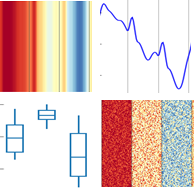
Visualizations often seek to aid viewers in assessing the big picture in the data, that is, to make judgments about aggregate properties of the data. In this paper, we present an empirical study of a representative aggregate judgment task: finding regions of maximum average in a series. We show how a theory of perceptual averaging suggests a visual design other than the typically-used line graph. We describe an experiment that assesses participants’ ability to estimate averages and make judgments based on these averages. The experiment confirms that this color encoding significantly outperforms the standard practice. The experiment also provides evidence for a perceptual averaging theory.

Ordered Line Graph Permuted Line Graph
Ordered Colorfield Woven Colorfield

Danielle Albers, Colin Dewey, Michael Gleicher. Sequence Surveyor: Leveraging Overview for Scalable Genomic Alignment Visualization. IEEE Transactions on Visualization and Computer Graphics (Proceedings Visualization / Information Visualization 2011), Volume 17 – December 2011.

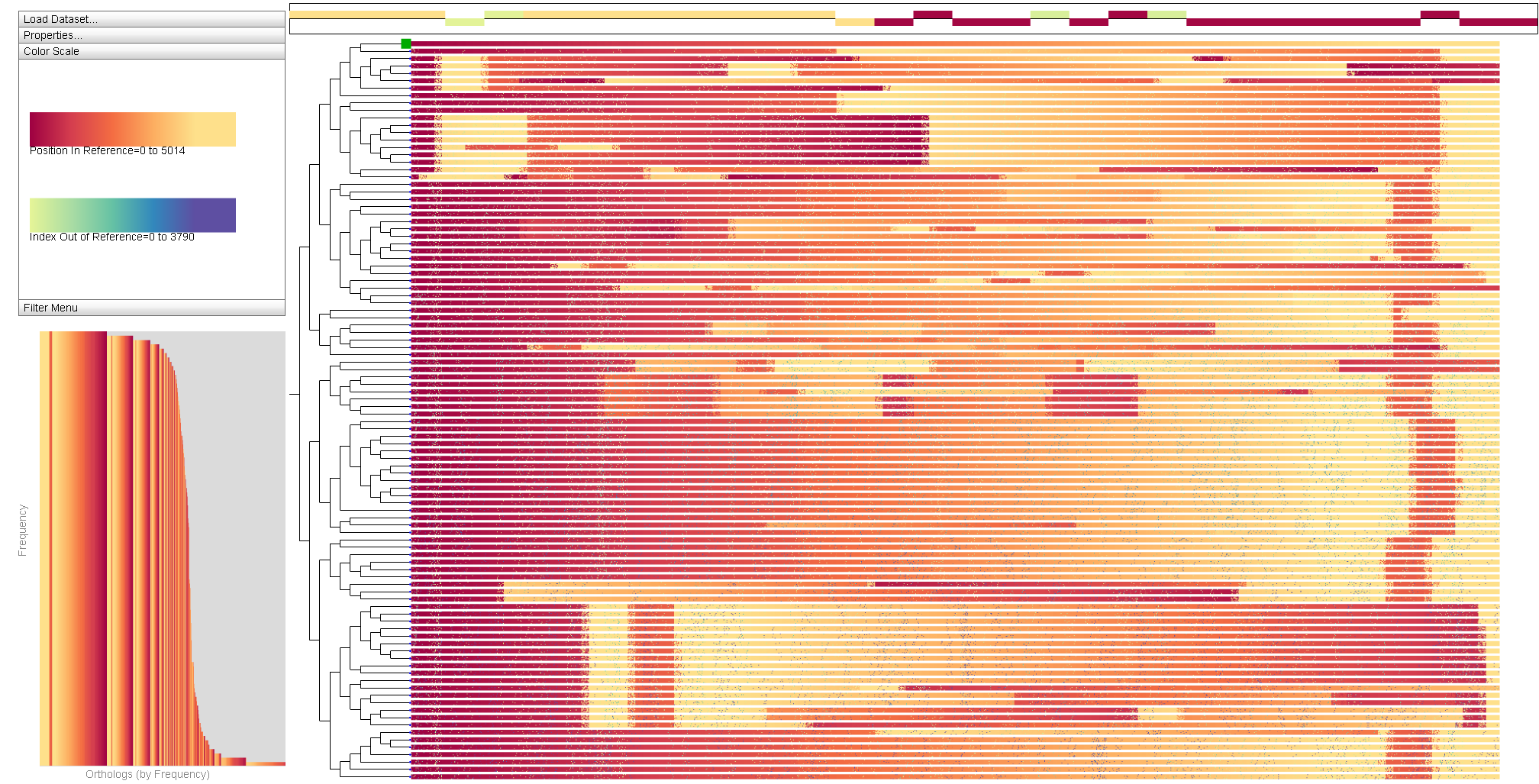
In this paper, we introduce overview visualization tools for large-scale multiple genome alignment data. Genome alignment visualization and, more generally, sequence alignment visualization are an important tool for understanding genomic sequence data. As sequencing techniques improve and more data becomes available, greater demand is being placed on visualization tools to scale to the size of these new datasets. When viewing such large data, we necessarily cannot convey details, rather we specifically design overview tools to help elucidate large-scale patterns. Perceptual science, signal processing theory, and generality provide a framework for the design of such visualizations that can scale well beyond current approaches. We present Sequence Surveyor,a prototype that embodies these ideas for scalable multiple whole-genome alignment overview visualization. Sequence Surveyor visualizes sequences in parallel, displaying data using variable color, position, and aggregation encodings. We demonstrate how perceptual science can inform the design of visualization techniques that remain visually manageable at scale and how signal processing concepts can inform aggregation schemes that highlight global trends, outliers, and overall data distributions as the problem scales. These techniques allow us to visualize alignments with over 100 whole bacterial-sized genomes.

TextDNA, a linguistic analysis tool based on the Sequence Surveyor design, is available at the Sequence Surveyor system page.


System, Sample Datasets and User’s Guide available here.
PDF and additional media available here.
Slides from VisWeek 2011 available here.

Danielle Albers, Colin Dewey, Michael Gleicher. Sequence Surveyor: Scalable Multiple Sequence Alignment Overview Visualization. VIZBI Workshop on Visualizing Biological Data – March 2011.

Sequence alignment visualization is an important tool for understanding genomics data. As sequencing techniques improve and more data becomes available, greater demand is being placed on existing tools to scale to the size of these new data sets. However, current tools do not scale to the challenges of growing data sets, as they focus on visualizing details of the data instead of global trends. We introduce overview visualization tools for large-scale multiple sequence alignment data. When viewing such large data, we necessarily cannot convey details, rather we specifically design overview tools to help elucidate large scale patterns. Perceptual science and signal processing theory provide a framework for the design of such visualizations that can scale well beyond current approaches. We present Sequence Surveyor, a prototype that embodies these ideas for scalable multiple sequence alignment overview visualization. We demonstrate how perceptual science and signal processing concepts can be used to support scalability in visualization and use these techniques to simultaneously visualize over 100 aligned genomic sequences.

Poster PDF available here.

Michael Gleicher, Danielle Albers, Rick Walker, Ilir Jusufi, Charles D. Hansen, Jonathan C. Roberts. Visual Comparison for Information Visualization. Information Visualization – Oct 2011.

Data analysis often involves the comparison of complex objects. With the ever increasing amounts and complexity of data, the demand for systems to help with these comparisons is also growing. Increasingly, information visualization tools support such comparisons explicitly, beyond simply allowing a viewer to examine each object individually. In this paper, we argue that the design of information visualizations of complex objects can, and should, be studied in general, that is independently of what those objects are. As a first step in developing this general understanding of comparison, we propose a general taxonomy of visual designs for comparison that groups designs into three basic categories, which can be combined. To clarify the taxonomy and validate its completeness, we provide a survey of work in information visualization related to comparison. Although we find a great diversity of systems and approaches, we find that all designs are assembled from the building blocks of juxtaposition, superposition, and explicit encodings. This initial exploration shows the power of our model, and suggests future challenges in developing a general understanding of comparative visualization and facilitating the development of more comparative visualization tools.

PDF available here.

Danielle Albers, Michael Gleicher. Perceptual Principles for Scalable Sequence Alignment Visualization. Proceedings of the 7th Symposium on Applied Perception in Graphics and Visualization, page 164, August 2010.

Sequence alignment visualization is an important tool in understanding genomics data. Current approaches have difficulty scaling to the larger datasets becoming available. In this paper, we survey some recent results from perceptual science and show how they provide ideas for creating more scalable alignment visualization tools. We identify several principles, discuss their ramifications to the design of alignment visualizations, and show their relevance in the limitations of current approaches. We believe that by considering these principles, we can design future alignment visualization systems that will better scale to future challenges.

PDF available here.

Danielle Albers, Michael Gleicher. Poster: Perceptual Principles for Scalable Sequence Alignment Visualization. IEEE Information Visualization Conference Poster Proceedings – 2010.

Sequence alignment visualization is an important tool for understanding genomics data. Current approaches have difficulty scaling to the larger data sets becoming available. In this work, we survey recent results from perceptual science and show how they provide ideas for creating more scalable alignment visualization tools. We identify several principles, discuss how they inform alignment visualization design, and show their relevance to the limitations of current approaches. We describe how these principles are used to inform the design of an alignment visualization prototype.


Poster PDF available here.

Abstract PDF available here.