Computer Science 766 Term
Project.
12/2002
Optical Character
Recognition (OCR) Based on OCRchie
Abstract: An
algorithm based on OCRchie is reviewed and implemented to recognize scanned in
files. The algorithm is carefully analyzed step by step. A few difficult
situations are separated out to give special solutions. OCRchie is robust
for scanned in files because of the invariant OCR vector for scaling and
translation. However, this method does not apply to projective or
affine transform because the invariance no long holds for such
condition.
Introduction:
OCR
converts image files content word information into pure text files. The
advantages of text files are obvious: First, text files require much less space
in storage. Second, text files are editable, indexable and searchable. It is a
lot easier to organize and achieve text files than image files of text. An
automatic method based on computer recognition, namely OCR, is then
developed.
Optical character
recognition is well established and has been applied to many areas for long
time. The newest commercial available software can recognize hands writing
easily. However, the research on the basic algorithms of the OCR is still very
interesting in the learning of computer vision.
In
this project, one of the OCR methods is reviewed and implemented in simple
cases. Its advantages and limitations are discussed. Some solution for difficult
situation is given.
Methods and materials:
The
method is based on OCRchie (K.
Marsden). There are 4 steps associate with the recognition process.
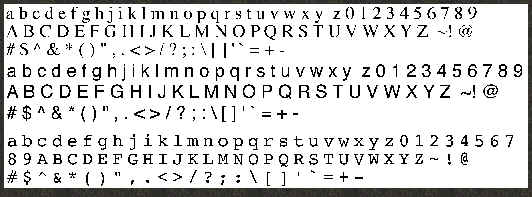
Figure 1: a sample of character recognition database
An
image of characters that have the same font as the to be recognized text is
input and saved into individual matrix.
2. Character
extraction.
This is the most important
step in OCRchie. A correct and precise extraction will ensure good recognition,
vise versa.
When a page of text is
scanned in, the first thing to do is defining the lines. A statistic method is
used in this step. Randomly draw lines through the image. The direction of least
broken by characters is the right direction of lines. A preprocessing of noise
suppression is necessary to avoid false detection of characters.


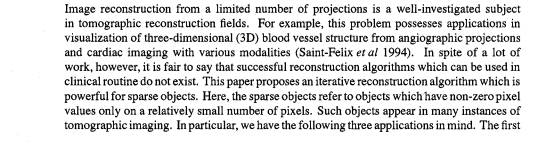
Figure 2: a sample of scanned in image.
When the line of the text is determined, image is first partitioned into a number of lines. Lines the are broken into characters by vertical projection, which is a projection the same line into a one dimensional space to find a raw segmentation in the same line.

Figure 3: Raw partitioned text image
However, when the projection of two disconnected characters is overlapped (fig.4), a more subtle segmentation is required.

Figure 4: characters have overlapped projection
Row scanning method is used to solve this problem.

Figure 5: an illustration of the row scanning technique. Adapted from Cs766 class note.
The result of row scanning figure 4 is figure 6.

Figure 6: the result of row scanning segmentation.
Then any disconnected part of input image is segmented.
3. Property extraction.
After the individual
characters is isolated, they are equally divided into 5X5=25 partition.

Figure 7:There are 29 properties associating with the 25 sub region.
There are 29 properties
associating with the 25 sub region:
The
first 25 elements are the ratio of black: white (grayscale) in each of 25
equal-sized sub regions of the character.
Property 26 is the grayscale across
the top 1/2 division.
Property 27 is the grayscale across the bottom 1/2
division.
Property 28 is the width/height ratio again scaled to
(0-255)
Property 29 is Indicator of a vertically disjoint character like j
and i.
These 29 properties compose
an OCR vector.
The
number of properties can be adjusted to accommodate the number of sub regions.
4. Properties comparison:
The
confidence function of detected characters and database is expressed as:

To
speed up the comparison, the last four properties are used to divide the
characters into a few sub groups based on their major difference. For example,
“l” and “t” in the group of the tall characters, “o” and “a” in the group of
short characters because their difference in property 28.
OCR result of sample image (figure 2) is:
“Image reconstruction from a
limited number of projections is a well-investigated subject in tomographic
reconstruction fields. For example, this problem possesses applications in
visualization of three-dimensional (3D) blood vessel structure from angiographic
projections and cardiac imaging with various modalities (Saint-Felix et a/
1994). In spite of a lot of work, however, it is fair to say that successful
reconstruction algorithms which can be used in clinical routine do not exist.
This paper proposes an iterative reconstruction algorithm which is powerful for
sparse objects. Here, the sparse objects refer to objects which have non-zero
pixel values only on a relatively small number of pixels. Such objects appear in
many instances of tomographic imaging. In particular, we have the following
three applications in mind. The first”
Although there is no false
recognition in this short test, this is partly because of the very good quality
of the input image. When the input image is poor, low confidence in recognition
is an often happening and results in mis-recognition.
Despite all those randomly
errors, there are a few common situation where OCR meet difficulties.
The
first one is that the characters in a sequence stick together and form something
not in the database. Characters
most prompt appear in this situation are r and f as shown in figure 8.


Figure 8: The stick together characters
Before better solution is
devised, a method partly based on guess is used. These multiple characters are
broken into smaller part from a sudden thinner part of the figure as shown by
the arrows. Then compare the
sub-divided part with existing database. If there is a better match, then accept
it. If worse then reject the subdivision and keep this as unrecognizable.
Another common cause of
mis-recognition is broken characters, which is a usual situation in repeatedly
copied materials. An “r” is often OCRed to be an “l” and something small and
unrecognizable. One solution of this problem is including the unrecognized part
with preceding character to improve the confidence.

Figure 9: A broken “r”
There are still many
exceptions to any general solution. Therefore, an interactive algorithm might be
necessary to decrease the chance of false recognition.
Conclusions:


Therefore, to recognize
characters from arbitrary sources like photo and movie, other recognition method
than OCRchie is necessary. For example, the five point invariant under
projection or image canonization. However, they are beyond the scope of this
project.
Reference: K. Marsden