Binary Search Tree
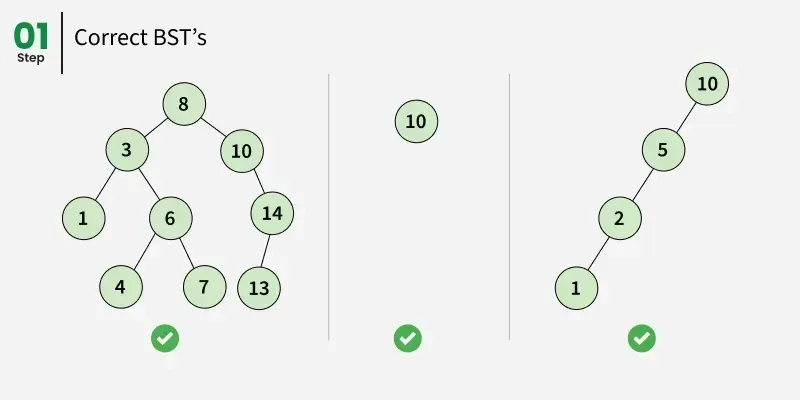
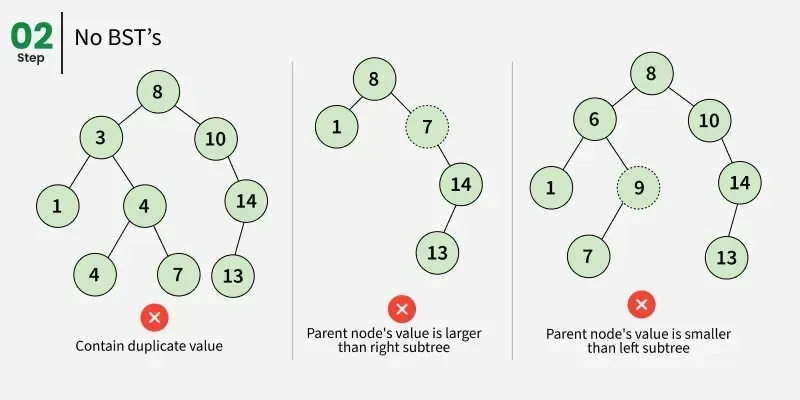
A Binary Search Tree (BST) is a type of binary tree data structure in which each node contains a unique key and
satisfies a specific ordering property
BST Information
- All nodes in the left subtree of a node contain values strictly less than the node’s value.
- All nodes in the right subtree of a node contain values strictly greater than the node’s value.
- BSTs are widely used in database indexing, symbol tables, range queries, and are foundational for advanced
structures like AVL tree and Red-Black tree. In problem solving, BSTs are used in problems where we need to
maintain sorted stream of data.
- Operations like search, insertion, and deletion work in O(Log n) time for a balanced binary search tree. In
the worst-case (unbalanced), these degrade to O(n). With self-balancing BSTs like AVL and Red Black Trees,
we can ensure the worst case as O(Log n).
Correct and Incorrect Binary Search Trees
More Information
Visit W3Schools.com