|
|
As a rough guide, chapter 1 describes what it's all about, chapter 2 is about directing the outcomes of physical simulations, chapter 3 is about fast rigid-body simulation, chapters 4-6 are about simulation culling or simulation level-of-detail, and chapter 7 concludes.
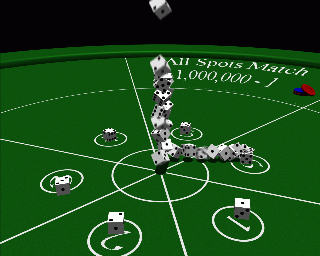
This thesis addresses controllable and scalable simulation for the purposes of computer animation. We describe a technique for directing the outcome of simulations by formulating the problem as one of probabilistic sampling. A Markov chain Monte Carlo (MCMC) algorithm is used to perform the sampling, which allows the generation of multiple animations from a desired distribution. Furthermore, if the distribution assigns probabilities according to the plausibility of an animation, then we can be certain that most of the sampled animations will appear reasonable to a viewer. A range of examples are presented from the domain of collision intensive rigid-body simulation, the majority of which could not be produced using previous technology. We also describe a new rigid-body simulation algorithm that was developed for this work.
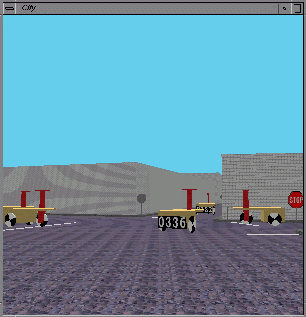
Scalable simulation is achieved through simulation culling, a method for focusing the computational effort on visible parts of a simulation. Aspects of the simulation that are not in view are not explicitly computed, thus saving large amounts of work. Approximations and random models are used to ensure that objects that leave the view re-enter when necessary in a plausible state, even though their full motion was not computed while out of view. A virtual fairground and a large virtual city are presented as case studies. These examples raise a number of open problems, which we discuss in some detail.
This thesis treats control and scale as largely independent problems,
yet we show that both may be viewed as sampling problems. We conclude with
a look at how direction and culling might be integrated to enable large-scale
virtual environments for realistic training and entertainment.