Research Interests
Computer architecture and microarchitecture; processor and memory systems; speculative execution and prediction; instruction delivery and address translation; and architecture for emerging workloads, including AI and large-language-model inference.
Biography
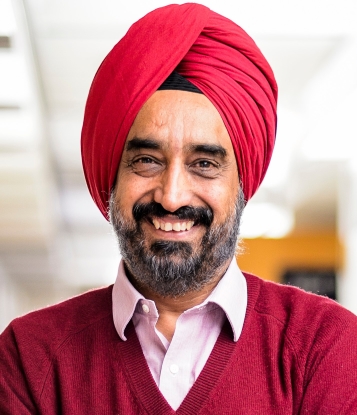
Gurindar (Guri) Sohi is a Vilas Research Professor, John P. Morgridge Professor, and E. David Cronon Professor of Computer Sciences at the University of Wisconsin–Madison. He received his Ph.D. in Electrical and Computer Engineering from the University of Illinois in 1985 and joined the Wisconsin faculty the same year. He served as Chair of the Department of Computer Sciences from 2004–2008 and again from 2017–2019.
Sohi's research has focused on the design of high-performance microprocessors and computer systems. His work helped establish several concepts that became important components of modern processor design, including dynamically scheduled out-of-order execution with precise state, high-bandwidth and non-blocking memory systems, thread-level speculation, memory dependence prediction, instruction reuse, and trace caches. His research group also developed the SimpleScalar architectural simulation infrastructure.
A recurring theme in his research has been to exploit predictable program behavior rather than requiring information to be known precisely before execution can proceed. Memory dependence prediction, for example, showed that a processor could predict whether loads and stores were dependent rather than first determining the precise addresses of all relevant memory operations before exploiting memory-level parallelism.
More recent work has examined instruction delivery and address translation, and architectural approaches for reducing the memory capacity and data-movement requirements of AI inference. This continues a long-standing emphasis on mechanisms that improve performance and efficiency while preserving the abstractions expected by software.
Sohi has supervised 22 Ph.D. students. His former students have gone on to research and technical leadership positions in academia and industry.
Selected Honors
- National Academy of Inventors, 2026
- IEEE Computer Society Computer Pioneer Award in Honor of the Women of ENIAC, 2025
- Hilldale Award, University of Wisconsin–Madison, 2018
- American Academy of Arts and Sciences, 2018
- IEEE Computer Society B. Ramakrishna Rau Award, 2016
- Vilas Research Professor, 2015–present
- BITS Pilani Distinguished Alumnus Award, 2014
- ACM/IEEE Eckert-Mauchly Award, 2011
- National Academy of Engineering, 2009
- ACM Fellow, 2004
- IEEE Fellow, 2004
- ACM SIGARCH Maurice Wilkes Award, 1999
Recent Work
-
Reducing LLM Inference Memory Bandwidth via Frequent Exponent Value Encoding
Maxwell Michalec, Swamit Tannu, and Gurindar S. Sohi, IEEE Computer Architecture Letters, vol. 25, no. 1, pp. 85-88, 2026. -
Instruction Block Movement with Coupled High-Level Program Sequencing
Shyam Murthy and Gurindar S. Sohi, arXiv:2406.06738, 2024. -
A Non-Traditional Approach to Assisting Data Address Translation
Shyam Murthy and Gurindar S. Sohi, arXiv:2408.15878, 2024.