CS310 Team Lab #13
Symbolic Solutions to Ordinary Differential Equations
Symbolic Computing
OBJECTIVES
- Understand what an ordinary differential equation (ODE) is.
- Learn how to construct an ODE from information given in a problem.
- Learn how to find the symbolic solution for the steady state of an ODE in Maple.
- Learn how to solve single ODEs symbolically in Maple.
- Learn how to solve systems of ODEs symbolically in Maple.
- Learn what a symbolic solution to an ODE looks like in Maple.
- Learn how to plot symbolic solutions to an ODE system in Maple.
INTRODUCTION
In this team lab you will see how to construct an ordinary differential equation using information that you are given.
You will also get experience solving single ordinary differential equations and systems of ordinary differential equations symbolically and plotting their solutions.
The first problem to be solved is one from chemical engineering:
A tank has an in-flow pipe and an out-flow pipe.
The flow rates are such that the level of solution in the tank remains constant.
The concentration of solution in the tank starts out at a particular value that is not the steady-state value.
A constant concentration of solution is added to the tank.
The concentration of solution in the tank changes until it reaches a steady-state concentration.
The following information about this problem is given:
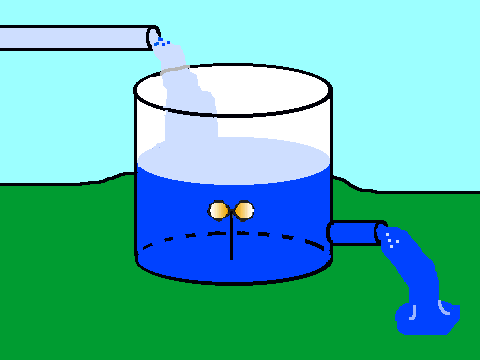
- At time t = 0, the tank contains a concentration of C0 pounds of salt per gallon of solution.
- The volume of solution in the tank is V gallons.
- The flow of water entering the tank contains salt in the concentration of Cin pounds of salt per gallon.
- The in-flow of salt solution enters the tank at a rate of r gallons/minute.
- The out-flow of salt water leaves the tank at the same rate of r gallons/minute.
- Assume that the salt solution in the tank is constantly mixed so that the concentration is uniform throughout the tank.
We wish to construct the ODE that describes the change in the amount of salt with respect to time.
In other words, find the ODE that describes the change in the amount of salt S(t) (lbs) in the tank with respect to time in terms of r and Cin. Note that S(t) is the function that describes the amount of salt in the tank (i.e., pounds of salt in the tank) and not the concentration.
The following ideas will assist us:
- The rate of change of salt in the tank is equal to the rate that salt comes in minus the rate that salt goes out.
- The rate of flow into the tank is the same as the rate of flow leaving the tank and is constant. Thus, the volume in the tank is also constant.
- The concentration of the outflow is the same as the concentration in the tank at any time due to our magic mixing that ensures the same concentration throughout the tank.
- Pay attention to the difference between concentration of salt and weight of salt. They are not the same.