Goodreads helps you keep track of books you want to read.
Start by marking “The Well-Grounded Java Developer: Vital techniques of Java 7 and polyglot programming” as Want to Read:
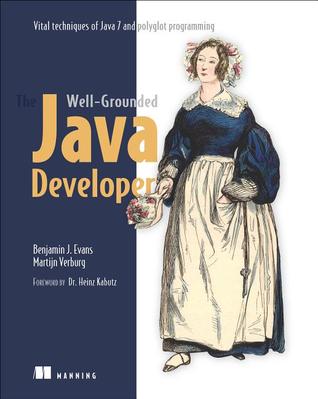
The Well-Grounded Java Developer: Vital techniques of Java 7 and polyglot programming
The Java community has always been dynamic and fast-moving, with constant innovation on the core platform as well as a vibrant community ecosystem. New JVM-based languages like Groovy, Scala, and Clojure are redefining what it means to be a Java developer. The core Standard and Enterprise APIs now co-exist with a large and growing body of open source technologies. Multicor
...more
Paperback, 462 pages
Published
July 18th 2012
by Manning Publications
(first published June 28th 2012)
Friend Reviews
To see what your friends thought of this book,
please sign up.
Reader Q&A
To ask other readers questions about
The Well-Grounded Java Developer,
please sign up.
Be the first to ask a question about The Well-Grounded Java Developer
This book is not yet featured on Listopia.
Add this book to your favorite list »
Community Reviews
(showing 1-30 of 493)

I expected so much more from this book. Unfortunately it covers too many topics and none in enough details. I can't really get my head exactly what this book should be used for, since the amount of details is not enough for any kind of serious reader.
Want to read about concurrency? Read Java Concurrency in Practice.
Want to read about Java Performance? Read Java Performance.
Want to read about Java 7 IO? There are couple of good books on that topic.
If the book was meant for booting-up a Java progr ...more
Want to read about concurrency? Read Java Concurrency in Practice.
Want to read about Java Performance? Read Java Performance.
Want to read about Java 7 IO? There are couple of good books on that topic.
If the book was meant for booting-up a Java progr ...more

Want to be a good Java developer? What do you need to know? Java of course. That part is easy.
But unless you are a brand new Java developer, you probably aren't up to speed on the latest Java 7 features, the threading model and how bytecode works. Or maybe you haven't caught up with the new JVM languages (Clojure, Scala and Jython.) The book also covers dependency injection, TDD and the like.
With lots of code examples, and clear explanations/writing style, I really enjoyed reading the book - and ...more
But unless you are a brand new Java developer, you probably aren't up to speed on the latest Java 7 features, the threading model and how bytecode works. Or maybe you haven't caught up with the new JVM languages (Clojure, Scala and Jython.) The book also covers dependency injection, TDD and the like.
With lots of code examples, and clear explanations/writing style, I really enjoyed reading the book - and ...more

Disclosure: I didn't read it cover-to-cover as I have most other technical books over the past... couple years? (Always?) Regardless: I read the GC bits in-depth and skimmed a lot of the rest of the text. There is a ton of useful information here -- some of it (like the sections on alternate JVM languages [1]) is mostly just for curiosity's sake, but there's also lot of really good stuff about the JVM itself (like the performance tuning bits). With the recent release of Java 8, this book (which
...more

Uneven, very uneven.
Part I & Part II are superbly detailed - most likely too much for someone who's just going to catch up with Java 7 (and that's the main purpose of the book, I assume). The rest is far too general - it pretty much mentions some important topics, but strongly avoids digging deeper. I realize that it's no possible to (for instance) cover full Scala and / or Closure course in polyglot JVM section, but there are some less specific topics that could get some love. Examples? Gra ...more
Part I & Part II are superbly detailed - most likely too much for someone who's just going to catch up with Java 7 (and that's the main purpose of the book, I assume). The rest is far too general - it pretty much mentions some important topics, but strongly avoids digging deeper. I realize that it's no possible to (for instance) cover full Scala and / or Closure course in polyglot JVM section, but there are some less specific topics that could get some love. Examples? Gra ...more

The title is very intriguing, but ... This book is overview which shows general trends and that's it. Some parts/chapters were redundant.
Part 1: Developing with Java 7. It was really interesting. Nothing to say.
Part 2: DI, Concurrency, class file, bytecode, perf - all these are just overview but very interesting. You won't be well grounded after reading this part ;-)
Part 3: There was a try to highlight basic features of Groovy, Scala, Clojure. But, it's impossible for such different langs using ...more
Part 1: Developing with Java 7. It was really interesting. Nothing to say.
Part 2: DI, Concurrency, class file, bytecode, perf - all these are just overview but very interesting. You won't be well grounded after reading this part ;-)
Part 3: There was a try to highlight basic features of Groovy, Scala, Clojure. But, it's impossible for such different langs using ...more

This book’s authors tried to write an all-around guide for the new coming Java developers.
But Java is too broad to cover all the different topics in just one book.
That’s the main problem with this book: an attempt to include everything that they could in 400 pages.
The book is great! There’s no other book that starts from low-level options of Java NIO and ends with a high-end view on current set of Java web frameworks.
Was it necessary? I doubt.
From my perspective it’s impossible to do what author ...more
But Java is too broad to cover all the different topics in just one book.
That’s the main problem with this book: an attempt to include everything that they could in 400 pages.
The book is great! There’s no other book that starts from low-level options of Java NIO and ends with a high-end view on current set of Java web frameworks.
Was it necessary? I doubt.
From my perspective it’s impossible to do what author ...more

Needs an update, some parts are outdated. But still good reading and detailed information, for example about the garbage collectors and profiling. The authors should work on an update. Today i think nobody has to be introduced into Groovy, Scala or Clojure any more. But including JEE or Spring Boot would be nice.
Great book to discover Java world around you!

Some interesting bits, but many things (i.e. TDD)are better explained in more focused books.
I liked the section on Java 7.
I liked the section on Java 7.

The advanced Java topics were pretty good, if a little brief.
I would have preferred less coverage of polyglot programming and more detailed coverage of topics and a few more topics as well.
Still, I found it a good introduction to some interesting new features, but it has left me feeling like I still need to follow it up with more research in most topics.
Maybe that's the point though?
I would have preferred less coverage of polyglot programming and more detailed coverage of topics and a few more topics as well.
Still, I found it a good introduction to some interesting new features, but it has left me feeling like I still need to follow it up with more research in most topics.
Maybe that's the point though?
A great introduction to the plethora of technologies and practices available to the JVM developers. Probably won't offer much to experienced developers, however the topics covered are really wide: from the Java7 features to alternative languages to concurrency to the platform's further evolution.
That said, I wish I had this book on my first/second year of professional development on the JVM.
That said, I wish I had this book on my first/second year of professional development on the JVM.

I liked the first section best, the discussion of vital new techniques in Java 7. There's a lot to use for the future there.
The other two sections (on polyglot programming) seemed fairly rushed. But that's probably to be expected - how could we really get to know three new languages and two new web development frameworks in 2/3 of a book?
Good intro to the topics, though.
The other two sections (on polyglot programming) seemed fairly rushed. But that's probably to be expected - how could we really get to know three new languages and two new web development frameworks in 2/3 of a book?
Good intro to the topics, though.

I read this book because I have started using Java 7 and thought that this would give me a good understanding of some of the new concepts in 7. I was disappointed. The examples where poorly written and in some cases contained errors. Some of the text was poorly worded and if interpreted wrong would actually lead to bad programming.Overall I cannot recommend this book.

To be short: below expectations. While it may serve as an overview of Java 7 and other JVM languages, that's pretty much it: an overview. The book is really lacking on details.

This book is a bit outdated as Java8 is already released. Still, the book provides wide look around on alternative JVM languages with starting points.


There are no discussion topics on this book yet.
Be the first to start one »