Goodreads helps you keep track of books you want to read.
Start by marking “Graph Databases” as Want to Read:
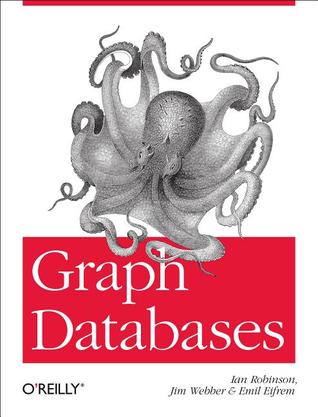
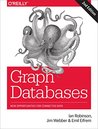
Graph Databases
by
Ian Robinson (Goodreads Author),
Jim Webber, Emil Eifrem
Discover how graph databases can help you manage and query highly connected data. With this practical book, you’ll learn how to design and implement a graph database that brings the power of graphs to bear on a broad range of problem domains. Whether you want to speed up your response to user queries or build a database that can adapt as your business evolves, this book sh
...more
Paperback, 224 pages
Published
June 17th 2013
by O'Reilly Media
(first published June 1st 2013)

Friend Reviews
To see what your friends thought of this book,
please sign up.
Reader Q&A
To ask other readers questions about
Graph Databases,
please sign up.
Be the first to ask a question about Graph Databases
This book is not yet featured on Listopia.
Add this book to your favorite list »
Community Reviews
(showing 1-30 of 484)

Note: You can get the 2nd edition for free from the authors here: http://graphdatabases.com/
A good introduction to Neo4j, less to graph databases in general. It goes from the basics, to using the query language Cypher, to some use-cases, internal technologies, and a quick primer on graph algorithms (Dijkstra's algorithm, A*).
Very American, the tone is overenthusiastic to the point of being hilarious:
A good introduction to Neo4j, less to graph databases in general. It goes from the basics, to using the query language Cypher, to some use-cases, internal technologies, and a quick primer on graph algorithms (Dijkstra's algorithm, A*).
Very American, the tone is overenthusiastic to the point of being hilarious:
...more
[...]graph databases lack the kind of schema-oriented data governance mechanisms we're familiar

Just finished reading an early release version of 'Graph Databases' (to be published next month). While perhaps overly focused on Neo4j (not surprising, given the three authors), this is the best reference out there on graph data modeling. That said, I have a few comments:
- Graphs needn't be as schemaless as the authors indicate. I haven't used Neo4j, but they claim that types/labels on nodes are not yet directly supported (p40), so I guess this is one reason why they downplay schemas and ontolo ...more
- Graphs needn't be as schemaless as the authors indicate. I haven't used Neo4j, but they claim that types/labels on nodes are not yet directly supported (p40), so I guess this is one reason why they downplay schemas and ontolo ...more

Interesting but feels like an advert for Neo4j, which is unsuprising given the authors. After reading this I feel like every problem I see could be solved with a graph database. I think I need to try it out on a personal project and see how it holds together.

This is an OK book. It's more about Neo4j and its Cypher language than about graph databases, but, well, why not. My biggest complain is about the written style: pick up one thing, which is pain for relation databases (recursive joins) and compare it with simple example using graph database. I've missed some real life performance comparisons. I like the idea of graph databases, but this book didn't help me to understand the pros and cons of it.

I already have some practical hands-on experience with graph databases so my interest in reading the book was to see how other practitioners covered the topic and to understand their points of view. The book is well written and easy to read. I read it over a couple of days. The main reason I only gave three stars was I felt the book was a bit too much focused on the Neo4J database and the Cypher query language. At times it read more like a Neo4J programmer's reference. While this is understandab
...more

This is not a book that surveys graph databases. In fact the only real comparison of graph databases is relegated to the appendix.
It is not even an objective account of 'native' graph databases; note, for instance, that the term 'hypergraph' only appears in that appendix.
Instead this is a thinly disguised user guide for the Neo4J databases with one incongruous chapter on 'graph theory' (no maths - good, since it would contradict a lot of what is said about 'property graphs') and graph algorithms ...more
It is not even an objective account of 'native' graph databases; note, for instance, that the term 'hypergraph' only appears in that appendix.
Instead this is a thinly disguised user guide for the Neo4J databases with one incongruous chapter on 'graph theory' (no maths - good, since it would contradict a lot of what is said about 'property graphs') and graph algorithms ...more

Good book as an introduction to graph databases. One of it's advantages is relative conciseness (I think it's about 200 pages long). IMHO it's mandatory reading before you start a project which relies on one of graph databases. Especially chapter 6 (database internals) is extremely useful. Without reading this book (or anything similar online) it's likely to happen then you and your teammates will use graph database in the same way as they used RDBMS.
Cons:
- it focuses too much on Neo4j
- does no ...more
Cons:
- it focuses too much on Neo4j
- does no ...more

An excellent overview of graph databases, along with cogent arguments for when they best fit into particular businesses, this book is an outstanding starting point for introducing programmers and their business partners to the benefits of graph data.
While not light on the technical details, it takes an opinionated "for" stance on Agile and Test-Driven Development, spending almost an entire chapter on how Graph Databases fit within an Agile, Test-Driven paradigm. I take no stance on well-implemen ...more
While not light on the technical details, it takes an opinionated "for" stance on Agile and Test-Driven Development, spending almost an entire chapter on how Graph Databases fit within an Agile, Test-Driven paradigm. I take no stance on well-implemen ...more
Wow, I'm sold on the benefits of graph data bases over relational databases, at least for big interconnected data that wants intricate multi-stage queries such as "Who are the authors recommended by friends of the people who read the books recommended by fans of Nabokov and David Mitchell and Penelope Fitzgerald?" In the appendix the authors acknowledge semantic triples can be stored in graph db (see "Blueprints Sail API" which seems to provide api for rdf queries into graph databases) for quick
...more

“Graph Databases” was more fun to read than the typical O'Reilly animal book. It was still full of technical information. I think because it was shorter (just under 200 pages( and had lots of pictures (graphs) that it felt less deep.
The book starts by being very clear what it in scope. It's the topic of graph databases and not a graph compute engine. I particularly liked the example of why relational databases fall short.
Cypher is used to show how to write queries. Taking a relational problem an ...more
The book starts by being very clear what it in scope. It's the topic of graph databases and not a graph compute engine. I particularly liked the example of why relational databases fall short.
Cypher is used to show how to write queries. Taking a relational problem an ...more

This is a pretty good introductions to graph databases. It is written by people involved in Neo4j, so it is heavy on Neo4j methodologies and syntax. That's OK, though, because there are some concrete examples of graph DB implementations, queries, and configuration.
About halfway through the book I was wondering why everyone is not using graph databases. They may not be the best choice for every data model, but it seems like they could be a viable choice in a lot of cases. However, when the book g ...more
About halfway through the book I was wondering why everyone is not using graph databases. They may not be the best choice for every data model, but it seems like they could be a viable choice in a lot of cases. However, when the book g ...more

Interesting introduction to the world of graph databases. Especially enlightening as to where it can be of use. Various examples are used that show it is not just a 'facebook-like' app that can benefit from this. The build up of the book was also good. From a basic understanding of graphs (yes, it helps to have some mathematical background in this area...) to the way one can build a database out of it and query it, ending with some detailed customer cases where a graph database was used.
One note ...more
One note ...more

I'm 99% certain I received this book from Neo Technology employee and this book is essentially a giant ad for Neo4j. Not a bad ad, just an ad.
If you're vaguely aware of what a graph is and have the notion you want to play with a graph database, Neo4j is definitely a great place to start. The book says it wants to be graph database neutral when really it's very specifically about Neo4j which some points on what is specific to that database and what is just generally expected of a graph.
Also some ...more
If you're vaguely aware of what a graph is and have the notion you want to play with a graph database, Neo4j is definitely a great place to start. The book says it wants to be graph database neutral when really it's very specifically about Neo4j which some points on what is specific to that database and what is just generally expected of a graph.
Also some ...more

Great introduction to the concepts of graph databases and Neo4J and Cypher in particular. A lot of the examples give actual Cypher queries and I felt that it would have been best to actually have a working development Neo4J/Cypher environment in order to be able to follow along and try out the specific examples.
Additionally, I recently found out that in version 2 of Neo4J one of the new features (Labels) move away from the repeated calls in the book to ensure your queries have a start node for ...more
Additionally, I recently found out that in version 2 of Neo4J one of the new features (Labels) move away from the repeated calls in the book to ensure your queries have a start node for ...more

A pretty good introduction to the topic, which helps you decide whether a graph database is appropropriate for your problem. However, there is not enough information to enough to actually get started.

Reads good, although provides only basic information on the subject. To really explore graph databases you need to dig deeper then this book.

I've found this book very informative. Authors tried to compare Graph DB to other types of DBs. I hope that this knowledge will help me to build a clever application.

Though focuses more towards Neo4j and Cypher, this book is a great book for introduction to graph database.

It should be titled "Intro to Neo4j" but otherwise it is ok.
General information to get you started.

With existing examples you can start

The title of the book could have very well been Introduction to Neo4J. The book is more about neo4j and its promotion than graph databases as such. The book gives good insight to cypher - the query language of neo4j and neo4j internals. But it also makes many over the top claims about neo4j's performance and the limitations of other and non graph databases. All the limitations regarding NEO4J are presented as an advantage or somehow not a limitation. Overall a good book if you want to learn abou
...more

While it makes a good overview of graph databases, I can't help but notice how much it focuses on Neo4j. When reading this book have in mind that the authors are all affiliated with Neo Technology -- making the book look like a marketing material for Neo4j. Still, if you don't fall into that trap, it would give you a good overview of what graph databases offer and what use cases they are suitable for.

just flash reading, not all but it's good as introduction, one thing that I got, if you ll dig something about relationship don't think twice, graph db is the best one..

A general insight into Graph Databases with a focus on Neo4j. Didn't flow that well but was impressed that it had a test based implementation focus - which gained it an extra star in my review.
Outlines the NoSQL family of DBs and provides useful comparisons and insights throughout. Quite a specialist book but if you are looking to use a Graph Database these is well worth reading.
Outlines the NoSQL family of DBs and provides useful comparisons and insights throughout. Quite a specialist book but if you are looking to use a Graph Database these is well worth reading.

I read early release.
So far, I felt graph database do have way to relief "join pain" in term of its native graph modeling.
What may be interested to hear is how partition of graph with billions of heterogeneous nodes cloud be made so that most heavily used query could be optimized from low bandwidth communications or etc.
So far, I felt graph database do have way to relief "join pain" in term of its native graph modeling.
What may be interested to hear is how partition of graph with billions of heterogeneous nodes cloud be made so that most heavily used query could be optimized from low bandwidth communications or etc.
Reads will till about the end where it loses focus. The last chapters are bad.
Very Neo4j centric to the point of not even naming others.
The discussion around Graph database modeling and ensuing architectural considerations of actually using them are really well written as is the comparative analysis.
Very Neo4j centric to the point of not even naming others.
The discussion around Graph database modeling and ensuing architectural considerations of actually using them are really well written as is the comparative analysis.

Very good (& short) book, covering the basics of graph databases, using the Neo4j for examples. Book covers how to represent models as graphs, how to organize data, perform queries, etc. It also briefly covers some internal details of Neo4j's implementation.

Great introduction to graph databases -- specifically Neo4j and Cypher. The approach in this book was helpful - iterating on problems and showing how one potential solution brings up new problems if you don't think it through.

Excellent intro to graphing databasing. Perfect mix of layman explanations and technical background. Very current too.
There are no discussion topics on this book yet.
Be the first to start one »