
Goodreads helps you keep track of books you want to read.
Start by marking “Otaku: Japan's Database Animals” as Want to Read:
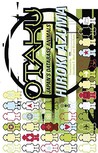
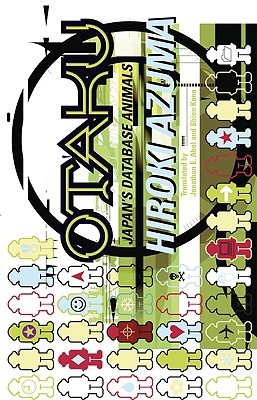
Otaku: Japan's Database Animals
Otaku Azuma (Center for the Study of World Civilizations, Tokyo Institute of Technology, Japan) philosophically explores the Japanese subculture of the otaku, which typically involves males between 18 and 40 who consume, produce, and collect comic books (manga), animated films (anime), and other products related to those forms of popular visual culture. He argues that the
...more
Paperback, 200 pages
Published
March 25th 2009
by Univ Of Minnesota Press
(first published November 20th 2001)
Friend Reviews
To see what your friends thought of this book,
please sign up.
Reader Q&A
To ask other readers questions about
Otaku,
please sign up.
Be the first to ask a question about Otaku
Community Reviews
(showing 1-30 of 492)
Hiroki Azuma is quite schematic in applying the principles of postmodern theory to narrative consumption, which he argues has now become 'database' consumption in contemporary [otaku] culture. Two trojan horses are at play here. "Japan" stands as a place that can either lead the way to an advanced, post-modern consumerist society or an exception that bends, but confirms, the rule, while "otaku" stands a fizzling subculture that has already been supplying the mainstream its vocabulary for a long
...more
Baudrillard... scelgo te!!!
Traduzione in inglese del celebre(?) Dōbutsuka suru posutomodan (動物化するポストモダン), di Azuma Hiroki.
I pro.
Azuma offre una brevissima cronistoria critica dell'approccio otaku all'animazione giapponese, e dei legami tra i due, cronistoria ben più sensata di quanto si legge di solito sull'argomento; difatti prende una decisa posizione contro il punto di vista continuista, cioè quello che vede l'animazione e il fumetto giappi eredi diretti (di solito non viene neanche spiegato
"As a result, instead of narratives creating characters, it became a general strategy to create character settings first, followed by works and projects, including the stories..."
I'm a lapsed anime fan. I spent 2002-2006 wondering why all the series out were so terrible. As Azuma puts it: "from the beginning the sense of realism in otaku genres has been weak; in many cases, even original works create worlds through citation and imitation of previous works." I could not agree more...
According t ...more
I'm a lapsed anime fan. I spent 2002-2006 wondering why all the series out were so terrible. As Azuma puts it: "from the beginning the sense of realism in otaku genres has been weak; in many cases, even original works create worlds through citation and imitation of previous works." I could not agree more...
According t ...more
Other reviews get the point across pretty well. Some arguments are overly-represented or fuzzy, but the writing is a deliberate attempt to be clear.
I'd be interested to see more contemporary writings. This is from 2001, and while it has very interesting analyses of novel games from that era, since then we've seen a huge boom in public visibility of video games, formation of 'classic gamers' and 'contemporary gamer' subgroups, etc. I was too young in 2001 to really know how those groups compare t ...more
Ever since attending a speech about Hiroki Azuma and his work, I've wanted to read this book. Now that I got around to it, I have to say I understand the content of his philosophy much better than after the short speech. It was an enlightening and interesting read, especially for an aspiring scholar of Japanese culture.
While the table of content doesn't give away what kind of style awaits, I found each chapter written in an easy to read and precise style. Azuma manages to communicate his ideas a ...more
I mentioned to someone how I was reading this book about how Japanese pop culture fans like to "remix" what they're reading into parodies and spinoffs.
My friend said to me, "Oh, you mean like how the Tale of Genji was read in the Edo period?"
I wish I could remember which of my friends said this, but they cut right through Azuma's BS for me. Indeed, a well-researched book was just published on the Genji subject: The Tale of Genji: Translation, Canonization, and World Literature
"Otaku" is a pretty ...more
My friend said to me, "Oh, you mean like how the Tale of Genji was read in the Edo period?"
I wish I could remember which of my friends said this, but they cut right through Azuma's BS for me. Indeed, a well-researched book was just published on the Genji subject: The Tale of Genji: Translation, Canonization, and World Literature
"Otaku" is a pretty ...more
For someone not well-versed in philosophy (myself, in this case), this might prove a challenging read. I picked up the book expecting to read about Japanese popular culture, and I was unpleasantly surprised when instead I was confronted with endless stream of postmodernist theory and had to grapple with ideas such as "rhizome model", "decline of the grand narratives", "rise of the simulacra" etc. I wasn't very thrilled about this onslaught of terminology I have never encountered before and didn'
...more
The book was enjoyable and a good stepping stone for those who are unfamiliar with theory (like I was). It started off strong, but by the end I found myself frustrated by how repetitive it became. Azuma makes a lot of good points and says a lot of interesting things, but he remains a bit inconsistent with how he says it -- one day i would feel he would miss the big picture, only to feel the next day like he was being too obtuse, too general, making too many abstractions. The book is about the ma
...more
I really think the translators could've found a better title for this. I don't know about anyone else, but to me the phrase "database animals" conjures images of monkeys in cubicles pounding out TPS reports, whereas Azuma is using both terms in a very specialized manner.
By "animal" he means that people in a Hegelian post-historical society as explicated by Kojeve are free to live in harmony with "nature," which in a modern consumerist society like the United States means that we live to consume ...more
Profound examination of how japanese otaku culture illustrates a post-modern way of life. You'll get a lot out of it if you are an otaku or obsessive fan of any type.
There's two types of ways to relate to the world. The Tree method involves a central narrative that shapes people's individual experiences by an inner core of truth. But the Database method has no narrative at all, and people relate to it in a way that's hard for me to sum up.
It's easier to use examples. If you are familiar with Neo ...more
There's two types of ways to relate to the world. The Tree method involves a central narrative that shapes people's individual experiences by an inner core of truth. But the Database method has no narrative at all, and people relate to it in a way that's hard for me to sum up.
It's easier to use examples. If you are familiar with Neo ...more
Azuma’s theoretical analysis of Japanese ‘Otaku’ culture provides some useful insights into Japanese intellectual life, ‘applied’ post-modernism and a phenomenon which, like rap from the other side of the world, has spread with globalisation. The footnotes are as valuable as the text.
It is perhaps a sign of that spread that my daughter (English) was able to point out quite quickly that two illustrations (of images of girls from Urusei Yatsura and Sailor Moon) had been transposed. It seems that t ...more
This was a challenging book to read. It is certainly an academic work and one belonging to a field I've never studied.
That said, it is not an unapproachable book. It is fairly short and Hiroki explains himself well while providing plenty of broader context for his views.
And I think his core arguments are compelling and fairly easy to follow. The book focuses on otaku culture but his database model of consumption can clearly be seen in many other contexts including in the West, many driven by the ...more
That said, it is not an unapproachable book. It is fairly short and Hiroki explains himself well while providing plenty of broader context for his views.
And I think his core arguments are compelling and fairly easy to follow. The book focuses on otaku culture but his database model of consumption can clearly be seen in many other contexts including in the West, many driven by the ...more
Hiroki Azuma not only manages to clearly explain complex postmodern theories from French philosophers, but also apply these to the Japanese subculture of the otaku by providing concrete examples, such as specific anime series or films. Halfway through the book gets exceedingly abstract while I did not regard these theories as relevant to Azuma's argument, per se.
Although Azuma offers an interesting viewpoint and theoretical framework, I agree with other reviews and find Azuma's vision on the ani ...more
His tale of the grand narrative being replaced by the database and the return to animality seemed quite like a grand narrative in its own right, but barring this contradiction, his theories seem quite insightful, even if their accuracy isn't perfect.
You don't have to be an otaku to understand this book, it is basically just Azuma picking a specific subculture that he felt predicted our transition to a truly postmodern state. That said, those familiar with otaku culture may gain additional insig ...more
Jul 14, 2015
Robert Fenner
rated it
really liked it
·
review of another edition
Shelves:
subculture,
nonfiction
Essential.
There are no discussion topics on this book yet.
Be the first to start one »
東 浩紀 in Japanese.
An influential Japanese literary critic.
More about Hiroki Azuma...
An influential Japanese literary critic.
Share This Book
No trivia or quizzes yet. Add some now »
“Between the otaku and Japan lies the United States.”
—
2 likes
“The history of otaku culture is one of adaptation, of how to domesticate American culture.”
—
1 likes
More quotes…