
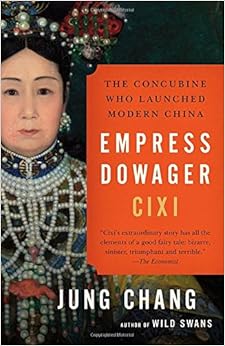

Empress Dowager Cixi
and over one million other books are available for Amazon Kindle. Learn more

Flip to back
Flip to front

Empress Dowager Cixi: The Concubine Who Launched Modern China Paperback – September 9, 2014
See all 10 formats and editions
Hide other formats and editions
| Amazon Price | New from | Used from |
|
Hardcover, Deckle Edge
"Please retry"
|
$14.04 | $11.94 |
|
Preloaded Digital Audio Player
"Please retry"
|
$91.15 | — |
$14.64
FREE Shipping on orders over $35.
In Stock.
Ships from and sold by Amazon.com.
Gift-wrap available.
NO_CONTENT_IN_FEATURE
Start reading Empress Dowager Cixi on your Kindle in under a minute.
Don't have a Kindle? Get your Kindle here, or download a FREE Kindle Reading App.
Don't have a Kindle? Get your Kindle here, or download a FREE Kindle Reading App.

Want to know our Editors' picks for the best books of the month? Browse Best Books of the Month, featuring our favorite new books in more than a dozen categories.
Product Details
Would you like to update product info or give feedback on images?.
|
Editorial Reviews
From Publishers Weekly
Her original first name was considered too inconsequential to enter in the court registry, yet she became the most powerful woman in 19th-century China. Born in 1835 to a prominent Manchu family, Cixi was chosen in 1852 by the young Chinese Emperor Xianfeng as one of his concubines. Literate, politically aware, and graceful rather than beautiful, Cixi was not Xianfeng's favorite, but she delivered his firstborn son in 1856. When the emperor died in 1861, he bequeathed his title to this son, with regents to oversee his reign. Cixi did not trust these men to competently rule China, so she conspired with Empress Zhen, her close friend and the deceased emperor's first wife, to orchestrate a coup. Memoirist Chang (Wild Swans) melds her deep knowledge of Chinese history with deft storytelling to unravel the empress dowager's behind-the-throne efforts to "Make China Strong" by developing international trade, building railroads and utilities, expanding education, and constructing a modern military. Cixi's actions and methods were at times controversial, and in 1898 she thwarted an assassination attempt sanctioned by Emperor Guangxu, her adopted son. Cixi's power only increased after this, and she finally exacted revenge on Guangxu just before her death in 1908. Illus.
--This text refers to the
Hardcover
edition.
From Booklist
Chang, author of the impeccable Wild Swans (2003), provides a revisionist biography of a controversial concubine who rose through the ranks to become a long-reigning, power- wielding dowager empress during the delicate era when China emerged from its isolationist cocoon to become a legitimate player on the international stage. As Cixi’s power and influence grew—she actually helped orchestrate the coup of 1861 that led directly to her own dominion as regent—she radically shifted official attitudes toward Western thoughts, ideas, trade, and technology. Ushering in a new era of openness, she not only brought medieval China into the modern age, but she also served double duty as a feminist champion and icon. When an author as thorough, gifted, and immersed in Chinese culture as Chang writes, both scholars and general readers take notice. --Margaret Flanagan
--This text refers to the
Hardcover
edition.
More About the Author

Discover books, learn about writers, read author blogs, and more.
Customer Reviews
Most Helpful Customer Reviews
41 of 41 people found the following review helpful
By
Dale Dellinger
on September 4, 2013
Format: Hardcover
Vine Customer Review of Free Product
(
What's this?
)
7 Comments
Sending feedback...
This is a very interesting book about Chinese history in the 19th and early 20th centuries, from the point of view of the central government -- specifically the Qing court.
At first look, this book appears to be a biography of one person, but in fact it gives great insight into China during an important (and I'd say misunderstood time) as it emerged from its isolation in the 19th century.
I must admit I didn't know much about the Empress Dowager Cixi before reading this book. When I was in Beijing several years ago, I had heard about her taking money earmarked for modernizing the navy and diverting it to build a stone pavilion shaped like a boat at the Summer Palace. My impression was that she was very backward, ignorant of the west, and controlling. On the contrary, the author, Jung Chang, is very sympathetic towards Cixi and he often showed me how my original impression of her was wrong, and she was much more than the caricature I had in my mind. She cared for China -- her motto was "China Strong". She was curious about the West and was impressed by the West's technology, their political systems, and how the West treated it's own citizens, and she adopted (or tried to adopt) many facets of the West. Many times, she was hampered by conservatives who didn't want to change.
This is also a book about a smart woman who became leader of 1/3 of the world's population -- not by birth, but by her own will -- when she was in her 20s and remained a strong force in a country for most of the rest of her life. It's telling that historians are not clear of what her original name was -- Cixi is an honorific name -- women's names weren't important enough to record, even when they were the emperor's mother.Read more ›
At first look, this book appears to be a biography of one person, but in fact it gives great insight into China during an important (and I'd say misunderstood time) as it emerged from its isolation in the 19th century.
I must admit I didn't know much about the Empress Dowager Cixi before reading this book. When I was in Beijing several years ago, I had heard about her taking money earmarked for modernizing the navy and diverting it to build a stone pavilion shaped like a boat at the Summer Palace. My impression was that she was very backward, ignorant of the west, and controlling. On the contrary, the author, Jung Chang, is very sympathetic towards Cixi and he often showed me how my original impression of her was wrong, and she was much more than the caricature I had in my mind. She cared for China -- her motto was "China Strong". She was curious about the West and was impressed by the West's technology, their political systems, and how the West treated it's own citizens, and she adopted (or tried to adopt) many facets of the West. Many times, she was hampered by conservatives who didn't want to change.
This is also a book about a smart woman who became leader of 1/3 of the world's population -- not by birth, but by her own will -- when she was in her 20s and remained a strong force in a country for most of the rest of her life. It's telling that historians are not clear of what her original name was -- Cixi is an honorific name -- women's names weren't important enough to record, even when they were the emperor's mother.Read more ›
Thank you for your feedback.
If this review is inappropriate, please let us know.
Sorry, we failed to record your vote. Please try again
21 of 22 people found the following review helpful
By
Z Hayes
HALL OF FAMETOP 50 REVIEWERVINE VOICE on September 17, 2013
Format: Hardcover
Vine Customer Review of Free Product
(
What's this?
)
2 Comments
Sending feedback...
When I was teaching in Singapore, the history syllabus covered the reign of the Empress Dowager Cixi, or Tzu- Hsi, as she was also known. I find her to be a complex and incredibly intelligent woman who bucked the restrictions imposed upon her gender during a period where females were extremely oppressed to rise through the ranks and become one of the most powerful women in China's history. Though Cixi has been reviled by many as a despot, author Jung Chang, who also wrote the amazing Wild Swans: Three Daughters of China, provides a starkly different perspective, one that shines the spotlight on the Empress Dowager's many achievements.
The book also provides the reader with a compelling look into the politics of governing China during the period. As one of Emperor Xianfeng's many royal concubines, Cixi distinguished herself not only because she provided the emperor with a son, but was also known for her political acumen, and this proved helpful when the Emperor died five years later. Employing cunning strategies, Cixi positioned herself as the real ruler of China, with her son installed as the Emperor Tongzhi.
Using recently accessible historical documents, primarily in Chinese, the author paints a compelling portrait of a woman who went against the grain and helped propel China into the modern era with significant strides being made in diverse fields such as economy, military, education, etc. One of the significant social reforms, at least in my opinion, was the banning of the cruel and antiquated practice of female foot-binding which saw many young women crippled way before their time, and prevented women from being more productive participants in society.Read more ›
The book also provides the reader with a compelling look into the politics of governing China during the period. As one of Emperor Xianfeng's many royal concubines, Cixi distinguished herself not only because she provided the emperor with a son, but was also known for her political acumen, and this proved helpful when the Emperor died five years later. Employing cunning strategies, Cixi positioned herself as the real ruler of China, with her son installed as the Emperor Tongzhi.
Using recently accessible historical documents, primarily in Chinese, the author paints a compelling portrait of a woman who went against the grain and helped propel China into the modern era with significant strides being made in diverse fields such as economy, military, education, etc. One of the significant social reforms, at least in my opinion, was the banning of the cruel and antiquated practice of female foot-binding which saw many young women crippled way before their time, and prevented women from being more productive participants in society.Read more ›
Thank you for your feedback.
If this review is inappropriate, please let us know.
Sorry, we failed to record your vote. Please try again
27 of 30 people found the following review helpful
By
Loves the View
VINE VOICE on January 10, 2014
Format: Hardcover
3 Comments
Sending feedback...
In total contravention to informed opinion, this author holds The Dowager Empress Cixi in awe and considers her a reformer. I was looking forward to what the author of Wild Swans: Three Daughters of China might have to say about Cixi and was disappointed that not much in the premise holds up. The Dowager's actions, as cited in this very text, contradict the author's premise.
Women's roles in history are obscured and underrated. Cixi is not obscure and takes on her shoulders the centuries of tradition and resistance to change that put China in a weak position to deal with the modern world. Jung Chang gives no information to show that Cixi's leadership did anything to reverse this trend. What she does show is that Cixi is a consummate politician.
Cixi lucked out in producing the first male child for the Emperor Xianfeng and was befriended his wife the empress. Upon the emperor's death, Cixi aligned with Empress Zhen and they plotted their way to power. Upon the death of her son, the Emperor Tongzhi, on whom her position depended, she adopted her three year old nephew who became Emperor Guangxu. She controlled him and wheedled his power away from him. When he became an adult, discredited and imprisoned him. She later murdered him, for the good of China... of course. None of her power was used to reform China. It seems to have been used to appoint people who would perpetuate her own power and kill others who (may have) threatened it. As could easily be predicted, she was against the Boxer rebels until they were effective; then she supported them; and then when they were squelched by the westerners, she cozied up to the westerners.Read more ›
Women's roles in history are obscured and underrated. Cixi is not obscure and takes on her shoulders the centuries of tradition and resistance to change that put China in a weak position to deal with the modern world. Jung Chang gives no information to show that Cixi's leadership did anything to reverse this trend. What she does show is that Cixi is a consummate politician.
Cixi lucked out in producing the first male child for the Emperor Xianfeng and was befriended his wife the empress. Upon the emperor's death, Cixi aligned with Empress Zhen and they plotted their way to power. Upon the death of her son, the Emperor Tongzhi, on whom her position depended, she adopted her three year old nephew who became Emperor Guangxu. She controlled him and wheedled his power away from him. When he became an adult, discredited and imprisoned him. She later murdered him, for the good of China... of course. None of her power was used to reform China. It seems to have been used to appoint people who would perpetuate her own power and kill others who (may have) threatened it. As could easily be predicted, she was against the Boxer rebels until they were effective; then she supported them; and then when they were squelched by the westerners, she cozied up to the westerners.Read more ›
Thank you for your feedback.
If this review is inappropriate, please let us know.
Sorry, we failed to record your vote. Please try again
Most Recent Customer Reviews
What Other Items Do Customers Buy After Viewing This Item?


