
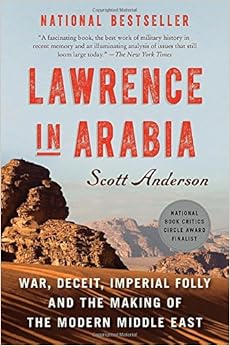

Lawrence in Arabia
and over one million other books are available for Amazon Kindle. Learn more

Flip to back
Flip to front


Lawrence in Arabia: War, Deceit, Imperial Folly and the Making of the Modern Middle East Paperback – June 3, 2014
See all 18 formats and editions
Hide other formats and editions
| Amazon Price | New from | Used from |
|
Multimedia CD
"Please retry"
|
—
|
$41.13 | $41.15 |
$11.33
FREE Shipping on orders over $35.
In Stock.
Ships from and sold by Amazon.com.
Gift-wrap available.


NO_CONTENT_IN_FEATURE
Start reading Lawrence in Arabia on your Kindle in under a minute.
Don't have a Kindle? Get your Kindle here, or download a FREE Kindle Reading App.
Don't have a Kindle? Get your Kindle here, or download a FREE Kindle Reading App.

Product Details
Would you like to update product info or give feedback on images?.
|
Editorial Reviews
Amazon.com Review
An Amazon Best Book of the Month, August 2013: Scott Anderson’s Lawrence in Arabia is a marvel of a history book. The research is impeccable. The story is fascinating and unforgettable. And the characters are so compelling that they seem to have been plucked from a novel. During World War I, the course of the modern day Middle East was set by a handful of young, low-ranking actors who exerted oversized influence on the region. Anderson focuses our attention on four men: a minor German diplomat and spy, an American oilman descended from the Yale family, a Romanian-born agronomist, and T.E. Lawrence himself. As we witness the western nations attempting to carve up a region that they were never able to master, these adventurous and often duplicitous men come to full life--none more so than Lawrence. The amount of research it must have taken to write this book is astounding. But there is no filler here: this is the kind of detail that causes the narrative to pop, that makes it live and breathe, and it will keep you reading long into the night. --Chris Schluep
--This text refers to the
Hardcover
edition.
From Booklist
*Starred Review* To historians, the real T. E. Lawrence is as fascinating as the cinematic version in Lawrence of Arabia is to movie fans. The many reasons interlock and tighten author Anderson’s narrative, yielding a work that can absorb scholarly and popular interest like. Start with Lawrence’s WWI memoir, Seven Pillars of Wisdom (1922). A rare-book collectible, it inspired many of the scenes in David Lean’s film and is also subject to cross-referencing interpretations of Lawrence’s veracity. For lyrical though Lawrence could be about Arab leaders and desert landscapes, he could also be enigmatically opaque about the truth of his role in events. Accordingly, Anderson embeds Lawrence and Seven Pillars in the wider context of the Arab revolt against Turkey, and that context is the British, French, German, and American diplomacy and espionage intended to influence the postwar disposition of the territories of the Ottoman Empire. Lawrence was Britain’s agent in this game, and the other powers’ agents, although none enjoy his historical celebrity, assume prominence in Anderson’s presentation. Its thorough research clothed in smoothly written prose, Anderson’s history strikes a perfect balance between scope and detail about a remarkable and mysterious character. --Gilbert Taylor
--This text refers to the
Hardcover
edition.
More About the Author

Discover books, learn about writers, read author blogs, and more.
Customer Reviews
Most Helpful Customer Reviews
271 of 292 people found the following review helpful
By
The Ginger Man
VINE VOICE on July 5, 2013
Format: Hardcover
Vine Customer Review of Free Product
(
What's this?
)
12 Comments
Sending feedback...
Scott Anderson brings an interesting background to this latest history of the modern Middle East. His father was an agricultural advisor to the US government. As a result, Anderson grew up largely in Taiwan and Korea, although he graduated from Gainesville High School in Florida. A novelist and veteran war reporter who has covered foreign conflicts for two decades in five countries, Anderson spent four years researching Lawrence in Arabia. He combines a feeling for foreign locales and an understanding of the realities of the battlefield with an extensive use of primary documents. The result is provocative history that reads like a political thriller.
Given the strategic importance of the Mid-East today, it is fascinating to read of the disproportionately large impact of some fairly low level functionaries in this "sideshow of a sideshow" (Lawrence's own words) in the run up to World War I. German academic and womanizer Curt Pruefer works to foment Arab jihad against British rule under the protection of Turkish rulers. Aaron Aaronsohn was a renowned agronomist and dedicated Zionist who gained the trust of the Ottoman governor by trying to relieve Syria of a plague of locusts. Twenty-seven year old American William Yale transitioned in a short eighteen months from roustabout duties in an Oklahoma oil field to Standard Oil's main agent charged with locating and securing oil in central Judea. Abdul-lah ibn Hussein is assigned by his father, Emir Hussein of Mecca, to sound out the British on supporting an Arab revolt in the Hejaz. Marching into history and legend was TE Lawrence who achieved the wholly unlikely transition from 21 year old archeologist in Syria in 1914 to head of a foreign Arab army in 1919, without a single day of military training.Read more ›
Given the strategic importance of the Mid-East today, it is fascinating to read of the disproportionately large impact of some fairly low level functionaries in this "sideshow of a sideshow" (Lawrence's own words) in the run up to World War I. German academic and womanizer Curt Pruefer works to foment Arab jihad against British rule under the protection of Turkish rulers. Aaron Aaronsohn was a renowned agronomist and dedicated Zionist who gained the trust of the Ottoman governor by trying to relieve Syria of a plague of locusts. Twenty-seven year old American William Yale transitioned in a short eighteen months from roustabout duties in an Oklahoma oil field to Standard Oil's main agent charged with locating and securing oil in central Judea. Abdul-lah ibn Hussein is assigned by his father, Emir Hussein of Mecca, to sound out the British on supporting an Arab revolt in the Hejaz. Marching into history and legend was TE Lawrence who achieved the wholly unlikely transition from 21 year old archeologist in Syria in 1914 to head of a foreign Arab army in 1919, without a single day of military training.Read more ›
Thank you for your feedback.
If this review is inappropriate, please let us know.
Sorry, we failed to record your vote. Please try again
126 of 135 people found the following review helpful
By
Deb Nam-Krane
VINE VOICE on July 31, 2013
Format: Hardcover
Vine Customer Review of Free Product
(
What's this?
)
6 Comments
Sending feedback...
T. E. Lawrence was legendary even before he died, and some of it was genuinely earned. What makes him a favorite in popular imagination is that he was disdainful of the myth that surrounded him- even when he was instrumental in perpetuating it. He is also, perhaps, seen as a reflection of what many commoners might have felt in the midst of the morass that became World War I: determined to get through the byzantine (no pun intended) negotiations and considerations that were foisted upon the world by outdated principles to arrive at an outcome that would allow his country some honor and the Arabs he was trying to help a measure of dignity that would justify the sacrifices he helped convince them to make. That he made great sacrifices himself is arguably the primary reason there was any honor or dignity to the outcome at all, but the compromises Lawrence had to make to get that far weighed far heavier on him.
This volume gives an extensive, nearly blow by blow account of how Lawrence came to the Middle East, why he became attached to the war effort and, most importantly, what he did. Anderson also explores the lives and careers of others who influenced the war and to some extent the outcome, including the German academic Curt Prufer, the American oilman William Yale and the Romanian-Palestinian-Jewish agronomist Aaron Aaronsohn. What all of three of the men shared was that they were also at one point spies, and each of them was trying to play the conflict in the Ottoman Empire to achieve their own ends. To do that, all of them needed the mercurial Djemal Pasha, one of the leaders of the Young Turks, in one way or another.
Lawrence, however, is the star.Read more ›
This volume gives an extensive, nearly blow by blow account of how Lawrence came to the Middle East, why he became attached to the war effort and, most importantly, what he did. Anderson also explores the lives and careers of others who influenced the war and to some extent the outcome, including the German academic Curt Prufer, the American oilman William Yale and the Romanian-Palestinian-Jewish agronomist Aaron Aaronsohn. What all of three of the men shared was that they were also at one point spies, and each of them was trying to play the conflict in the Ottoman Empire to achieve their own ends. To do that, all of them needed the mercurial Djemal Pasha, one of the leaders of the Young Turks, in one way or another.
Lawrence, however, is the star.Read more ›
Thank you for your feedback.
If this review is inappropriate, please let us know.
Sorry, we failed to record your vote. Please try again
103 of 116 people found the following review helpful
By
Steven A. Peterson
TOP 500 REVIEWERVINE VOICE on July 21, 2013
Format: Hardcover
Vine Customer Review of Free Product
(
What's this?
)
5 Comments
Sending feedback...
This is a fascinating book, for the most part well written. While the key character is T. E. Lawrence, the book is formally structured as an examination of the roles of and sometimes interaction among four characters: T. E. Lawrence (of Arabia), Curt Prufer (umlaut over the u), Aaron Aaronson, and William Yale.
A brief note about each. Lawrence began World War I on an archaeological expedition--and ended up as a celebrity. Prufer was a German who worked for German interests in the Middle East. Aaronsohn was a Zionist and an agronomist trying to enhance agriculture in Jewish areas. He also developed a spy network as World War I broke out. Yale was of the family after whom the college was named. He was, at the outset of WW I, an official for Standard Oil of New York (now Mobil) seeking access to lands that might be rich in oil. During the war, he became a representative of the United States' foreign policy apparatus.
The book provides considerable depth to each of these persons--but Lawrence is at the center. He is portrayed as somewhat enigmatic, someone who was almost a tragic character. While he fought for Arab independence, he knew of nefarious schemes by the English and French to be dominant forces in the Middle East after the war's end. He was a decent person who ended up tolerating acts of violence (such as watching as prisoners were killed after surrendering). The author suggests that, after a period of time at war, he became someone afflicted with Post traumatic stress disorder.
Aaronsohn, too, was an important figure. He tried to advance Zionist ideals and saw that working with Great Britain might be the best pathway. He developed an espionage network in the Middle East, with his sister as a key player.Read more ›
A brief note about each. Lawrence began World War I on an archaeological expedition--and ended up as a celebrity. Prufer was a German who worked for German interests in the Middle East. Aaronsohn was a Zionist and an agronomist trying to enhance agriculture in Jewish areas. He also developed a spy network as World War I broke out. Yale was of the family after whom the college was named. He was, at the outset of WW I, an official for Standard Oil of New York (now Mobil) seeking access to lands that might be rich in oil. During the war, he became a representative of the United States' foreign policy apparatus.
The book provides considerable depth to each of these persons--but Lawrence is at the center. He is portrayed as somewhat enigmatic, someone who was almost a tragic character. While he fought for Arab independence, he knew of nefarious schemes by the English and French to be dominant forces in the Middle East after the war's end. He was a decent person who ended up tolerating acts of violence (such as watching as prisoners were killed after surrendering). The author suggests that, after a period of time at war, he became someone afflicted with Post traumatic stress disorder.
Aaronsohn, too, was an important figure. He tried to advance Zionist ideals and saw that working with Great Britain might be the best pathway. He developed an espionage network in the Middle East, with his sister as a key player.Read more ›
Thank you for your feedback.
If this review is inappropriate, please let us know.
Sorry, we failed to record your vote. Please try again
Most Recent Customer Reviews
What Other Items Do Customers Buy After Viewing This Item?


