
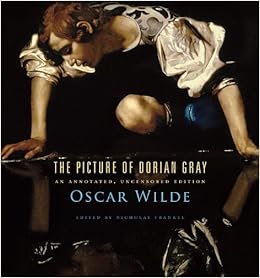

The Picture of Dorian Gray (Illustrated)
and over one million other books are available for Amazon Kindle. Learn more

Flip to back
Flip to front

The Picture of Dorian Gray: An Annotated, Uncensored Edition Hardcover – May 11, 2011
$26.73
FREE Shipping on orders over $35.
Only 8 left in stock (more on the way).
Ships from and sold by Amazon.com.
Gift-wrap available.

NO_CONTENT_IN_FEATURE
Start reading The Picture of Dorian Gray (Illustrated) on your Kindle in under a minute.
Don't have a Kindle? Get your Kindle here, or download a FREE Kindle Reading App.
Don't have a Kindle? Get your Kindle here, or download a FREE Kindle Reading App.

FBI profiler Karen Vail's current case takes readers back to the beginning, with flashbacks to her rookie days as an NYPD patrol officer. "Spectrum" is a great way for new readers of the series to jump into the action. Learn more
Product Details
Would you like to update product info or give feedback on images?.
|
Editorial Reviews
From Publishers Weekly
Starred Review. First published in 1890 in Lippincott's Monthly Magazine and the following year in novel form, The Picture of Dorian Gray categorically changed Victorian Britain and the landscape of literature. An ostentatious, self-confessed aesthete, known for his wit and intellect, Wilde not only had to endure his prose being labeled "poisonous" and "vulgar," but also suffer its use as evidence in the ensuing trial, resulting in his eventual imprisonment for crimes of "gross indecency." Frankel's introduction provides a deft preliminary analysis of the novel itself—exploring etymology and extensive editorial alterations (both accidental and deliberate)—and offers valuable insight into the socio-cultural juxtaposition of aristocratic Victorian society and the London underworld. The original typescript provides the unique opportunity to examine what was considered acceptable in both the US and UK at the time. Intriguing annotations allude to Wilde's influences and enterprising range of reference, incorporating art, poetry, literature, Greek mythology, philosophy, and fashion (certain to inspire further reading; an appendix is provided). Comparisons are drawn between Dorian Gray and Wilde's other literary output, as well as to the work of Walter Pater. Numerous illustrations subtly compliment Frankelÿs inferences. A fine contextualization of a major work of fiction profoundly interpreted, ultimately riveting. (Mar.)
Review
Nicholas Frankel has done a great service to Oscar Wilde's readers in preparing this new edition of The Picture of Dorian Gray. His introduction and annotations deepen our understanding not only of Wilde the writer but of the political and sexual milieu in which he lived and published. This is the kind of scholarship that reminds us why scholarship matters. (David Leavitt)
Frankel's extensive annotations reveal that the homoerotic qualities of the novel are deeply encoded within it and cannot be excised by the removal of a few phrases...If the restored text is interesting primarily as a social document of what was and was not permissible in England in the 1890s, it poignantly reveals an author desperately at war with his society and with himself. (Ruth Franklin New Republic online 2011-03-23)
In pages redolent of fin-de-siecle languor and sparkling with bons mots, Wilde's only novel raises several seriously troubling questions: If one could live a life of absolute freedom, would the result be happiness or a nightmare? How much of our complex selves do we deny or sacrifice to conventional morality? ...This Harvard edition of the untouched typescript is thus a necessary acquisition for any serious student of Wilde's work...After this enthralling novel has left you shaken and disturbed, look for deeper understanding in Nicholas Frankel's superb annotated edition. (Michael Dirda Washington Post 2011-03-31)
This edition gives us a chance to read Wilde's text in a form as close as possible to the way he meant it to appear. (Sarah Boslaugh PopMatters 2011-03-31)
The Picture of Dorian Gray categorically changed Victorian Britain and the landscape of literature. An ostentatious, self-confessed aesthete, known for his wit and intellect, Wilde not only had to endure his prose being labeled "poisonous" and "vulgar," but also suffer its use as evidence in the ensuing trial, resulting in his eventual imprisonment for crimes of "gross indecency." Frankel's introduction provides a deft preliminary analysis of the novel itself--exploring etymology and extensive editorial alterations (both accidental and deliberate)--and offers valuable insight into the socio-cultural juxtaposition of aristocratic Victorian society and the London underworld. The original typescript provides the unique opportunity to examine what was considered acceptable in both the U.S. and UK at the time...A fine contextualization of a major work of fiction profoundly interpreted, ultimately riveting. (Publishers Weekly (starred review) 2011-04-04)
There is a good argument that the published version of the novel is not quite true to its author's intent or achievement, and Nicholas Frankel, who teaches English at Virginia Commonwealth University, has now set things right--and in handsome fashion. He has skillfully restored Wilde's original version, and in the manner of other great annotated editions, supplied readers with everything anyone would need to know about Oscar Wilde, The Picture of Dorian Gray, and their lives and times...The entire product--novel and critical/biographical material--makes fascinating reading. (Philip Terzian Weekly Standard 2011-04-02)
Like Harvard University Press's other beautiful annotated editions of classics, this is both handsome and instructive. (David Azzolina Library Journal 2011-05-01)
A richly annotated and illustrated volume edited by Nicholas Frankel. It is not often that a piece of serious scholarship is accorded such deluxe treatment, and in this case it is a cause for real celebration, for Frankel has provided a wealth of supplemental material and visual matter, as well as a "Textual Introduction" and a series of notes that explain references and cultural context, help the reader understand the editing processes, and point out the passages that were singled out for deletion...This annotated version [is] a treasure for scholars and for anyone with a serious interest in Wilde, the 1890s, and Aestheticism. (Brooke Allen Barnes & Noble Review 2011-04-26)
Oscar Wilde's novel The Picture of Dorian Gray may have outraged Victorian society even more had his editor not deleted sections of his original text...These passages and others deemed risky 120 years ago now appear for the first time. (Nicholas Clee The Times 2011-05-07)
Splendid...Profusely illustrated and annotated, the edition's most interesting feature will be a comparison of the original hand-emended typescript with the two main published versions, each of which toned down the novel in a vain effort to avoid the notoriety that descended on both the work and its author...Frankel's edition is a major contribution to the studies of Wilde and of late Victorian legal, sexual, and social contexts...Required reading for students and scholars of Wilde and his period. (George Bornstein Times Literary Supplement 2011-06-17)
In this day of Kindles, e-books and tweets, this is truly a magnificent job of bookmaking. Oversized, lavishly illustrated and gorgeously presented, Oscar would have loved it. The text is examined minutely, with a variety of comparisons from various publications of the novel, as well as Wilde's original manuscript...The scholarship is both astounding and informative. The annotator and editor, Nicholas Frankel, easily and effortlessly places the modern reader in Wilde's time and place, London's late Victorian Age in London. There is still a tingle to Dorian's story of endless debauchery while he remains looking pure and innocent for decades and the painting ages and grows monstrous, reflecting his sins and crimes. Strangely, the book seems more modern than one would imagine. Rather than merely a potboiler from two centuries back, Wilde's genius imbues the story with a strange and haunting immediacy, and a cautionary tale for us all: Be careful what you wish for. One could hardly wish for a more beautifully accoutered book. (Alan W. Petrucelli Pittsburgh Examiner 2011-06-29)
There is much to be appreciated in this handsome scholarly edition...Frankel [is] an accomplished guide and this edition an elegant resource that enables us to admire all the more deeply the portrait and the artist. (Richard Gibson Books & Culture 2011-07-01)
The version that Wilde submitted to Lippincott's [published for the first time by Harvard University Press] is the better fiction. It has the swift and uncanny rhythm of a modern fairy tale--and Dorian is the greatest of Wilde's fairy tales. (Alex Ross New Yorker 2011-08-08)
It's a revelatory exercise to examine the text of Wilde's original typescript...It yields a deeper understanding of its author and of the hypocrisy and intolerance of late-Victorian English society which led to his two-year imprisonment for "gross indecency."...With this landmark edition we have the opportunity, until now denied us, to read what the author originally wrote. It unquestionably belongs on every Wildean's shelves. (Joel Greenberg The Australian 2011-07-30)
Oscar Wilde's The Picture of Dorian Gray has the distinction of being one of the few pieces of literature that grew longer by way of being censored...It's seven chapters longer than his original version, which now appears for the first time from Harvard University Press by way of a brilliant scholarly presentation of the typescript Wilde submitted to the Philadelphia office of Lippincott's magazine...The typescript (in the UCLA library, but published for the first time here) is, besides truer to Wilde's original intentions, a vastly better novel than the one Lippincott's Monthly Magazine published, say nothing of the much expanded version England's Ward, Lock and Company brought out the next year, the one most of us know. To call Wilde's earlier version leaner would miss the flavor and point of this aestheticism-drenched work, but it's a swifter, bolder, more uncompromising, less moralistic and in every respect more affecting work than its edited, rewritten, or otherwise censored versions. Who would have thought a scholarly edition would be the one to have? But everything about Nicholas Frankel's revelatory new edition of the typescript of The Picture of Dorian Gray is game-changing. Reading it is like viewing a painting by Michelangelo--one of the great artists Wilde named while explaining what he meant by the phrase "the love that dare not speak its name" (to cheers of applause from some in the gallery) in the 1895 court trial--returned to its original glory by deeply knowledgeable, painstaking art restorers. If it did nothing more, Frankel's exhaustively researched book would be a dream presentation of any edition of Dorian Gray, lavishly illustrated with relevant art of the period, including priceless photographs that bring the details of Wilde's book, amazingly now 120 years old, to vivid life. The typescript text is larded with footnotes I'm tempted to describe as being as absorbing as Wilde's writing, except that no one's writing is more captivating than Wilde's, as Frankel would be the first to agree...Entry by entry, Frankel's painstaking explication of the culture Wilde's writing was both a product of, and immeasurably advanced, makes this dense, brilliant book comprehensible...Once through this seminal text with all its notes, illustrations, and explanations, the drive is to go back and re-read the typescript (easily recognized by its larger typeface) all over again, just because it's such a terrific book. (Tim Pfaff Bay Area Reporter 2011-08-25)
We now have an uncensored Dorian, which is very exciting...[It's] a beautifully produced volume: lots of white space, helpful annotations, crisp color illustrations and photographs. (Nikolai Endres Victorians 2011-05-01)
[A] superbly annotated new edition of Wilde's novel. (Colm Tóibín London Review of Books 2012-05-10)
Frankel's extensive annotations reveal that the homoerotic qualities of the novel are deeply encoded within it and cannot be excised by the removal of a few phrases...If the restored text is interesting primarily as a social document of what was and was not permissible in England in the 1890s, it poignantly reveals an author desperately at war with his society and with himself. (Ruth Franklin New Republic online 2011-03-23)
In pages redolent of fin-de-siecle languor and sparkling with bons mots, Wilde's only novel raises several seriously troubling questions: If one could live a life of absolute freedom, would the result be happiness or a nightmare? How much of our complex selves do we deny or sacrifice to conventional morality? ...This Harvard edition of the untouched typescript is thus a necessary acquisition for any serious student of Wilde's work...After this enthralling novel has left you shaken and disturbed, look for deeper understanding in Nicholas Frankel's superb annotated edition. (Michael Dirda Washington Post 2011-03-31)
This edition gives us a chance to read Wilde's text in a form as close as possible to the way he meant it to appear. (Sarah Boslaugh PopMatters 2011-03-31)
The Picture of Dorian Gray categorically changed Victorian Britain and the landscape of literature. An ostentatious, self-confessed aesthete, known for his wit and intellect, Wilde not only had to endure his prose being labeled "poisonous" and "vulgar," but also suffer its use as evidence in the ensuing trial, resulting in his eventual imprisonment for crimes of "gross indecency." Frankel's introduction provides a deft preliminary analysis of the novel itself--exploring etymology and extensive editorial alterations (both accidental and deliberate)--and offers valuable insight into the socio-cultural juxtaposition of aristocratic Victorian society and the London underworld. The original typescript provides the unique opportunity to examine what was considered acceptable in both the U.S. and UK at the time...A fine contextualization of a major work of fiction profoundly interpreted, ultimately riveting. (Publishers Weekly (starred review) 2011-04-04)
There is a good argument that the published version of the novel is not quite true to its author's intent or achievement, and Nicholas Frankel, who teaches English at Virginia Commonwealth University, has now set things right--and in handsome fashion. He has skillfully restored Wilde's original version, and in the manner of other great annotated editions, supplied readers with everything anyone would need to know about Oscar Wilde, The Picture of Dorian Gray, and their lives and times...The entire product--novel and critical/biographical material--makes fascinating reading. (Philip Terzian Weekly Standard 2011-04-02)
Like Harvard University Press's other beautiful annotated editions of classics, this is both handsome and instructive. (David Azzolina Library Journal 2011-05-01)
A richly annotated and illustrated volume edited by Nicholas Frankel. It is not often that a piece of serious scholarship is accorded such deluxe treatment, and in this case it is a cause for real celebration, for Frankel has provided a wealth of supplemental material and visual matter, as well as a "Textual Introduction" and a series of notes that explain references and cultural context, help the reader understand the editing processes, and point out the passages that were singled out for deletion...This annotated version [is] a treasure for scholars and for anyone with a serious interest in Wilde, the 1890s, and Aestheticism. (Brooke Allen Barnes & Noble Review 2011-04-26)
Oscar Wilde's novel The Picture of Dorian Gray may have outraged Victorian society even more had his editor not deleted sections of his original text...These passages and others deemed risky 120 years ago now appear for the first time. (Nicholas Clee The Times 2011-05-07)
Splendid...Profusely illustrated and annotated, the edition's most interesting feature will be a comparison of the original hand-emended typescript with the two main published versions, each of which toned down the novel in a vain effort to avoid the notoriety that descended on both the work and its author...Frankel's edition is a major contribution to the studies of Wilde and of late Victorian legal, sexual, and social contexts...Required reading for students and scholars of Wilde and his period. (George Bornstein Times Literary Supplement 2011-06-17)
In this day of Kindles, e-books and tweets, this is truly a magnificent job of bookmaking. Oversized, lavishly illustrated and gorgeously presented, Oscar would have loved it. The text is examined minutely, with a variety of comparisons from various publications of the novel, as well as Wilde's original manuscript...The scholarship is both astounding and informative. The annotator and editor, Nicholas Frankel, easily and effortlessly places the modern reader in Wilde's time and place, London's late Victorian Age in London. There is still a tingle to Dorian's story of endless debauchery while he remains looking pure and innocent for decades and the painting ages and grows monstrous, reflecting his sins and crimes. Strangely, the book seems more modern than one would imagine. Rather than merely a potboiler from two centuries back, Wilde's genius imbues the story with a strange and haunting immediacy, and a cautionary tale for us all: Be careful what you wish for. One could hardly wish for a more beautifully accoutered book. (Alan W. Petrucelli Pittsburgh Examiner 2011-06-29)
There is much to be appreciated in this handsome scholarly edition...Frankel [is] an accomplished guide and this edition an elegant resource that enables us to admire all the more deeply the portrait and the artist. (Richard Gibson Books & Culture 2011-07-01)
The version that Wilde submitted to Lippincott's [published for the first time by Harvard University Press] is the better fiction. It has the swift and uncanny rhythm of a modern fairy tale--and Dorian is the greatest of Wilde's fairy tales. (Alex Ross New Yorker 2011-08-08)
It's a revelatory exercise to examine the text of Wilde's original typescript...It yields a deeper understanding of its author and of the hypocrisy and intolerance of late-Victorian English society which led to his two-year imprisonment for "gross indecency."...With this landmark edition we have the opportunity, until now denied us, to read what the author originally wrote. It unquestionably belongs on every Wildean's shelves. (Joel Greenberg The Australian 2011-07-30)
Oscar Wilde's The Picture of Dorian Gray has the distinction of being one of the few pieces of literature that grew longer by way of being censored...It's seven chapters longer than his original version, which now appears for the first time from Harvard University Press by way of a brilliant scholarly presentation of the typescript Wilde submitted to the Philadelphia office of Lippincott's magazine...The typescript (in the UCLA library, but published for the first time here) is, besides truer to Wilde's original intentions, a vastly better novel than the one Lippincott's Monthly Magazine published, say nothing of the much expanded version England's Ward, Lock and Company brought out the next year, the one most of us know. To call Wilde's earlier version leaner would miss the flavor and point of this aestheticism-drenched work, but it's a swifter, bolder, more uncompromising, less moralistic and in every respect more affecting work than its edited, rewritten, or otherwise censored versions. Who would have thought a scholarly edition would be the one to have? But everything about Nicholas Frankel's revelatory new edition of the typescript of The Picture of Dorian Gray is game-changing. Reading it is like viewing a painting by Michelangelo--one of the great artists Wilde named while explaining what he meant by the phrase "the love that dare not speak its name" (to cheers of applause from some in the gallery) in the 1895 court trial--returned to its original glory by deeply knowledgeable, painstaking art restorers. If it did nothing more, Frankel's exhaustively researched book would be a dream presentation of any edition of Dorian Gray, lavishly illustrated with relevant art of the period, including priceless photographs that bring the details of Wilde's book, amazingly now 120 years old, to vivid life. The typescript text is larded with footnotes I'm tempted to describe as being as absorbing as Wilde's writing, except that no one's writing is more captivating than Wilde's, as Frankel would be the first to agree...Entry by entry, Frankel's painstaking explication of the culture Wilde's writing was both a product of, and immeasurably advanced, makes this dense, brilliant book comprehensible...Once through this seminal text with all its notes, illustrations, and explanations, the drive is to go back and re-read the typescript (easily recognized by its larger typeface) all over again, just because it's such a terrific book. (Tim Pfaff Bay Area Reporter 2011-08-25)
We now have an uncensored Dorian, which is very exciting...[It's] a beautifully produced volume: lots of white space, helpful annotations, crisp color illustrations and photographs. (Nikolai Endres Victorians 2011-05-01)
[A] superbly annotated new edition of Wilde's novel. (Colm Tóibín London Review of Books 2012-05-10)
Customer Reviews
Most Helpful Customer Reviews
287 of 313 people found the following review helpful
By
Guillermo Maynez
on February 6, 2001
Format: Mass Market Paperback
12 Comments
Sending feedback...
This sophisticated but crude novel is the story of man's eternal desire for perennial youth, of our vanity and frivolity, of the dangers of messing with the laws of life. Just like "Faust" and "The immortal" by Borges.
Dorian Gray is beautiful and irresistible. He is a socialité with a high ego and superficial thinking. When his friend Basil Hallward paints his portrait, Gray expresses his wish that he could stay forever as young and charming as the portrait. The wish comes true.
Allured by his depraved friend Henry Wotton, perhaps the best character of the book, Gray jumps into a life of utter pervertion and sin. But, every time he sins, the portrait gets older, while Gray stays young and healthy. His life turns into a maelstrom of sex, lies, murder and crime. Some day he will want to cancel the deal and be normal again. But Fate has other plans.
Wilde, a man of the world who vaguely resembles Gray, wrote this masterpiece with a great but dark sense of humor, saying every thing he has to say. It is an ironic view of vanity, of superflous desires. Gray is a man destroyed by his very beauty, to whom an unknown magical power gave the chance to contemplate in his own portrait all the vices that his looks and the world put in his hands. Love becomes carnal lust; passion becomes crime. The characters and the scenes are perfect. Wilde's wit and sarcasm come in full splendor to tell us that the world is dangerous for the soul, when its rules are not followed. But, and it's a big but, it is not a moralizing story. Wilde was not the man to do that. It is a fierce and unrepressed exposition of all the ugly side of us humans, when unchecked by nature. To be rich, beautiful and eternally young is a sure way to hell. And the writing makes it a classical novel. Come go with Wotton and Wilde to the theater, and then to an orgy. You'll wish you age peacefully.
Dorian Gray is beautiful and irresistible. He is a socialité with a high ego and superficial thinking. When his friend Basil Hallward paints his portrait, Gray expresses his wish that he could stay forever as young and charming as the portrait. The wish comes true.
Allured by his depraved friend Henry Wotton, perhaps the best character of the book, Gray jumps into a life of utter pervertion and sin. But, every time he sins, the portrait gets older, while Gray stays young and healthy. His life turns into a maelstrom of sex, lies, murder and crime. Some day he will want to cancel the deal and be normal again. But Fate has other plans.
Wilde, a man of the world who vaguely resembles Gray, wrote this masterpiece with a great but dark sense of humor, saying every thing he has to say. It is an ironic view of vanity, of superflous desires. Gray is a man destroyed by his very beauty, to whom an unknown magical power gave the chance to contemplate in his own portrait all the vices that his looks and the world put in his hands. Love becomes carnal lust; passion becomes crime. The characters and the scenes are perfect. Wilde's wit and sarcasm come in full splendor to tell us that the world is dangerous for the soul, when its rules are not followed. But, and it's a big but, it is not a moralizing story. Wilde was not the man to do that. It is a fierce and unrepressed exposition of all the ugly side of us humans, when unchecked by nature. To be rich, beautiful and eternally young is a sure way to hell. And the writing makes it a classical novel. Come go with Wotton and Wilde to the theater, and then to an orgy. You'll wish you age peacefully.
Thank you for your feedback.
If this review is inappropriate, please let us know.
Sorry, we failed to record your vote. Please try again
100 of 110 people found the following review helpful
By
Ellen
on March 13, 2000
Format: Paperback
1 Comment
Sending feedback...
I first was introduced to Dorian Gray through a book club, and I thought 'Oh no, Oscar Wilde, here I go, another hard to read boring society book". I was wrong. Within the first two chapters of Dorian Gray I was intrigued and fascinated. This book deals with several issues that are as important now as they are today: the way our culture worships beauty and youth, an admiration that boarders on homosexual love, virtues, the differences between men and women, and what art is and what makes it truly art. Dorian Gray is a beautiful young man, who sees a portrait of himself and says "How sad it is! I shall grow old, and horrible, and dreadful. But this picture will remain always young...If only it were the other way! If it were I who was to be always young, and the portrait to grow old...I would give my soul for that!" The book takes off from there, leading you from a small theater to great parties. While younger readers may find some of the wording as tough as an old gym shoe, anyone older than 13 with an interest in mystery, romance, and how society runs, will find this a pleasurable and haunting read.
Thank you for your feedback.
If this review is inappropriate, please let us know.
Sorry, we failed to record your vote. Please try again
100 of 111 people found the following review helpful
By
Daniel Jolley
HALL OF FAMETOP 500 REVIEWERVINE VOICE on June 8, 2002
Format: Paperback
Comment
Sending feedback...
The Picture of Dorian Gray is a mesmerizing read dominated by two amazing personalities. Dorian Gray is certainly interesting, but I was much more impressed by his friend and mentor Lord Henry Wotton. Dorian is a perfectly nice, well-meaning young man when we first meet him in the studio of the painter Basil Hallward. Hallward in fact is so drawn to the youth that he draws his greatest inspiration from painting him and just being with him. It is the influence of Hallward's friend Lord Henry which leads to Gray's downfall. There are few characters in literature as decadent, witty, and somehow enchanting as Lord Henry. He is never at a loss for words, fatalistic observations of life and people, sarcastic philosophical musings, and brilliantly devious ideas. Among his world of social decadents and artistic do-nothings, his charm remains redoubtable and highly sought-after. Gray immediately falls under his spell, soon devoting himself to living life to its fullest and enjoying his youth and beauty to the utmost. He solemnly wishes that he could remain young and beautiful forever, that Hallward's exquisite picture of him should bear the marks of age and debauchery rather than himself. To his surprise and ultimate horror, he finds his wish fulfilled. Small lines and creases first appear in the portrait, but after he cruelly breaks the heart of an unfortunate young actress who then takes her own life, the first real signs of horror and blood manifest themselves on his portrait. His love for the ill-fated Sibyl Vane is a sordid, heartbreaking tale, and it marks the culmination of his descent into debauchery. He frequents opium dens and houses of ill repute, justifying all of his worst actions to himself, while the influence of Lord Henry continues to work its black magic on his soul.Read more ›
Thank you for your feedback.
If this review is inappropriate, please let us know.
Sorry, we failed to record your vote. Please try again
40 of 43 people found the following review helpful
By
Alan W. Petrucelli
on June 29, 2011
Format: Hardcover
Comment
Sending feedback...
What made Oscar Wild(e)?
The Belknap Press of Harvard University Press has published a new edition of Oscar Wilde's The Picture of Dorian Gray. While there is no burning need for such a volume in the day of Lady Gaga and marriage equality, it's important to remember that Wilde spent two years in prison for being gay and for having the guts (stupidity?) to flaunt his sexuality. In many ways, it was the flaunting rather than the act themselves that so angered his persecutors.
And Dorian Gray, his first and only novel, was certainly a shot fired directly into the heart of Victorian prudery.
And in this day of Kindles, e-books and tweets, this is truly a magnificent job of bookmaking. Oversized, lavishly illustrated and gorgeously presented, Oscar would have loved it. The text is examined minutely, with a variety of comparisons from various publications of the novel, as well as Wilde's original manuscript. While there's nothing particularly new to discover in the emendations from the sources, merely a reinforcement of the outrageousness inherent in the piece, the scholarship is both astounding and informative.
The annotator and editor, Nicholas Frankel, easily and effortlessly places the modern reader in Wilde's time and place, London's late Victorian Age in London. There is still a tingle to Dorian's story of endless debauchery while he remains looking pure and innocent for decades and the painting ages and grows monstrous, reflecting his sins and crimes.
Strangely, the book seems more modern than one would imagine. Rather than merely a potboiler from two centuries back, WIlde's genius imbues the story with a strange and haunting immediacy, and a cautionary tale for us all: Be careful what you wish for.
One could hardly wish for a more beautifully accoutered book.
The Belknap Press of Harvard University Press has published a new edition of Oscar Wilde's The Picture of Dorian Gray. While there is no burning need for such a volume in the day of Lady Gaga and marriage equality, it's important to remember that Wilde spent two years in prison for being gay and for having the guts (stupidity?) to flaunt his sexuality. In many ways, it was the flaunting rather than the act themselves that so angered his persecutors.
And Dorian Gray, his first and only novel, was certainly a shot fired directly into the heart of Victorian prudery.
And in this day of Kindles, e-books and tweets, this is truly a magnificent job of bookmaking. Oversized, lavishly illustrated and gorgeously presented, Oscar would have loved it. The text is examined minutely, with a variety of comparisons from various publications of the novel, as well as Wilde's original manuscript. While there's nothing particularly new to discover in the emendations from the sources, merely a reinforcement of the outrageousness inherent in the piece, the scholarship is both astounding and informative.
The annotator and editor, Nicholas Frankel, easily and effortlessly places the modern reader in Wilde's time and place, London's late Victorian Age in London. There is still a tingle to Dorian's story of endless debauchery while he remains looking pure and innocent for decades and the painting ages and grows monstrous, reflecting his sins and crimes.
Strangely, the book seems more modern than one would imagine. Rather than merely a potboiler from two centuries back, WIlde's genius imbues the story with a strange and haunting immediacy, and a cautionary tale for us all: Be careful what you wish for.
One could hardly wish for a more beautifully accoutered book.
Thank you for your feedback.
If this review is inappropriate, please let us know.
Sorry, we failed to record your vote. Please try again
Customer Images
Most Recent Customer Reviews
What Other Items Do Customers Buy After Viewing This Item?


