Michelangelo: A Life in Six Masterpieces and over one million other books are available for Amazon Kindle. Learn more
Buy New
$19.41
Qty:1
  • List Price: $29.95
  • Save: $10.54 (35%)
FREE Shipping on orders over $35.
In Stock.
Ships from and sold by Amazon.com.
Gift-wrap available.
Michelangelo: A Life in S... has been added to your Cart
Trade in your item
Get a $3.57
Gift Card.
Have one to sell? Sell on Amazon
Flip to back Flip to front
Listen Playing... Paused   You're listening to a sample of the Audible audio edition.
Learn more
See all 2 images

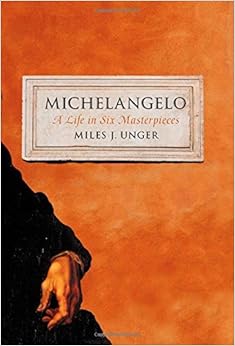
Michelangelo: A Life in Six Masterpieces Hardcover – July 22, 2014


See all 2 formats and editions Hide other formats and editions
Amazon Price New from Used from
Kindle
"Please retry"
Hardcover
"Please retry"
$19.41
$17.01 $14.97
$19.41 FREE Shipping on orders over $35. In Stock. Ships from and sold by Amazon.com. Gift-wrap available.


Frequently Bought Together

Michelangelo: A Life in Six Masterpieces + Mona Lisa: A Life Discovered
Price for both: $37.50

Buy the selected items together
  • Mona Lisa: A Life Discovered $18.09

Customers Who Bought This Item Also Bought

NO_CONTENT_IN_FEATURE

Image
Looking for the Audiobook Edition?
Tell us that you'd like this title to be produced as an audiobook, and we'll alert our colleagues at Audible.com. If you are the author or rights holder, let Audible help you produce the audiobook: Learn more at ACX.com.

Product Details

  • Hardcover: 448 pages
  • Publisher: Simon & Schuster (July 22, 2014)
  • Language: English
  • ISBN-10: 1451678746
  • ISBN-13: 978-1451678741
  • Product Dimensions: 9.3 x 6.6 x 1.4 inches
  • Shipping Weight: 1.6 pounds (View shipping rates and policies)
  • Average Customer Review: 4.7 out of 5 stars  See all reviews (24 customer reviews)
  • Amazon Best Sellers Rank: #23,331 in Books (See Top 100 in Books)

Editorial Reviews

From Booklist

*Starred Review* In Michelangelo, the poet Ludovico Ariosto saw an “angel divine.” The Michelangelo whom Unger delivers in this probing biography is no angel but, rather, a fallible, even devious man. But he does evince powers not previously seen among mere human beings in the way he defies the limits that previously circumscribed the role of the artist. Readers watch this multifaceted genius acquire these powers as the bold young sculptor of the Pieta matures—dazzling Rome with his David, stunning the Vatican with his Sistine Chapel Creation, baffling his rich patrons with his daringly innovative Medici tombs, and finally overwhelming the ecclesiastical hierarchy with his anarchic Last Judgment. But the creative feat that unifies this string of masterpieces is Michelangelo’s forging of an entirely new conception of the artist. No longer just a craftsman intent on selling his skills, the artist that emerges in Michelangelo is a visionary insistent on his imaginative autonomy. Michelangelo thus fashions a dynamic new identity for the artist as a revolutionary, opening new vistas for an astonished society. Unger highlights Michelangelo’s singular achievement without glossing over the defects in his mercurial character—or obscuring the corruption and violence pervading his Renaissance world. A masterful portrait of a dauntingly complex figure. --Bryce Christensen

Review

"A deeply human tribute to one of the most accomplished and fascinating figures in the history of Western culture." (Michael Washburn The Boston Globe)

“Provides insightful perspective on Michelangelo. . . . [Michelangelo] made some of the most enduring art in Western civilization and profoundly changed the way we think about artists. Thoughtful exploration of his work, which this book most definitely is, will always be rewarding." (Travis Nichols The Washington Post)

“Accessible and compelling. . . . Unger’s real focus is on how the political and ideological climate of Michelangelo’s day affected his art, and here he is authoritative and highly illuminating.” (Adam Kirsch Christian Science Monitor)

“Unger insightfully guides readers through both Michelangelo's life and the culture and history of the times. . . . [He] displays keen, humane judgments in interpreting Michelangelo's life by focusing on his motives and talent. The artist's life was complicated, but Unger finds a narrative path that keeps the reader on course for an enlightened biography.” (David Hendricks San Antonio Express)

“Unger is an astute critic and an able storyteller; his remapping of familiar territory should please both readers new to Michelangelo and those who think they know him inside out.” (Ann Landi ArtNews)

"This may be the one indispensable guide for encountering the artist on his home turf. There are hundreds of books about Michelangelo di Lodovico di Buonarroti Simone, his art and his times. But few bring it all together in such an entertaining and enlightening whole." (Bill Marvel The Dallas News)

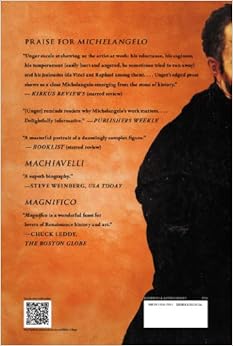
“Highly readable. . . . [Unger] reminds readers why Michelangelo's work matters. . . . Delightfully informative.” (Publishers Weekly)

“A masterful portrait of a dauntingly complex figure.” (Booklist (starred review))

“Unger excels at showing us the artist at work: his reluctance, his caginess, his temperament (easily hurt and angered, he sometimes tried to run away) and his jealousies (da Vinci and Raphael among them). . . . His edged prose shows us a clear Michelangelo emerging from the stone of history.” (Kirkus (starred review))

“Unger has read extensively on each of the six creations in his focus, but more importantly, he’s also stepped back and looked at them, and that fresh outlook makes his book very lively reading. . . . It’s enormously intelligent and engaging contribution to the shelf and a perfect introduction to this most towering and problematic of all artists.” (Steve Donoghue Open Letters Monthly)

“Author Miles J. Unger states Michelangelo was 'the prototype of the temperamental genius, beholden to no one and responsible only to the dictates of his own inspiration'. . . . The heart of Michelangelo is a full portrayal of this fascinating character, but the book also devotes a full chapter to each of his most famous works.” (Helen Gallagher Seattle Post-Intelligencer)

"Mr. Unger is a good, popular art historian who understands the moods of the artist and his times." (The Economist)

“Part biography, part art analysis and thoroughly tantalizing. By focusing on six works, presented in chronological order, Unger presents a portrait of the artist that gives a panoramic view of Michelangelo’s life but also focuses keenly on putting the artwork itself in context, giving readers the whys and wherefores that provide a rich, provocative understanding.” (Catherine Mallette The Star-Telegram (Fort Worth))

“This may be the one indispensable guide for encountering the artist on his home turf. There are hundreds of books about Michelangelo di Lodovico di Buonarroti Simone, his art and his times. But few bring it all together in such an entertaining and enlightening whole.” (Bill Marvel Dallas Morning News)

“Magisterial. . . . This fascinating new biography is highly recommended as a guide to anyone seeking to understand the immortal works of art created by this singular man.” (Catherine Hollis BookPage)

More About the Author

Miles Unger is the author of three books on Renaissance Italy -Michelangelo: A Life in Six Masterpieces (Simon & Schuster, 2014), Machiavelli: A Biography (Simon & Schuster, 2011) and Magnifico: The Brilliant Life and Violent Times of Lorenzo de' Medici (Simon & Schuster, 2008). He is also the author of The Watercolors of Winslow Homer (W. W. Norton & Co, 2001). He currently writes on art and culture for The Economist, and from 1999-2010 was a contributing writer for The New York Times. From 1996-2002 he served as the Managing Editor of Art New England. He has written for numerous national and regional publications, including The Boston Globe, Boston Magazine, and ARTnews. Miles Unger's extensive knowledge and love of the Italian language and culture was fostered during the five years he lived in Florence. He continues to travel as often as he can to the country. Miles currently lives near Boston with his wife, Jody, and two daughters, Emily and Rachel.

Visit him at his website: www.milesjunger.com

Customer Reviews

4.7 out of 5 stars
5 star
18
4 star
5
3 star
1
2 star
0
1 star
0
See all 24 customer reviews
We saw the Pieta at St. Peters in the Vatican.
Richard Margason
Mr. Unger is also clearly an expert in this times period which makes for good reading.
Timothy Haugh
Wish I'd bought a hard copy version--I probably will.
S. E. Mcneil

Most Helpful Customer Reviews

9 of 10 people found the following review helpful By Timothy Haugh TOP 1000 REVIEWERVINE VOICE on August 20, 2014
Format: Hardcover
In nearly every field there are numerous practitioners who are competent and some who might even be termed great; however, there are never more than a handful that are geniuses so far above the norm that nearly everyone will have heard of them. (Actors: Olivier, Brando. Golfers: Palmer, Nicholas, Woods. Presidents: Washington, Lincoln, Roosevelt.) There are some who are so influential that their names live on even centuries after their death. (Shakespeare, for example. Or Isaac Newton.)

Asked to name a sculptor, how many names would the average person be able to come up with? Rodin? Maybe. Michelangelo? Certainly. I mention sculpting for a couple reasons. First, despite his varied achievements in art, Michelangelo considered himself primarily a sculptor. Second, though as a painter and architect Michelangelo was superior, in these fields he had competition. As a sculptor, he had no equal. With his paintings, he would be mentioned in the same breath as Leonardo and Raphael. Add in the sculptures, and Michelangelo stands alone.

As such, Michelangelo continues to be written about often over 500 years after his birth. We continue to wonder about him and try to understand his genius. The latest attempt in this endless process is this biography by Mr. Unger.

Subtitled “A Life in Six Masterpieces”, Mr. Unger sparks discussions of various periods in Michelangelo’s long life with certain achievements: the Pietà as the triumph of his youth, the Giant (usually referred to as the David) as his ultimate masterpiece, the Sistine Chapel Ceiling as his mastering of fresco, the Medici Tombs as the facility of a master sculptor, the Last Judgment as a late masterpiece, and his work on St. Peter’s Basilica as the drive in the decline of his later years.
Read more ›
Comment Was this review helpful to you? Yes No Sending feedback...
Thank you for your feedback. If this review is inappropriate, please let us know.
Sorry, we failed to record your vote. Please try again
13 of 16 people found the following review helpful By David Wineberg TOP 1000 REVIEWER on July 30, 2014
Format: Hardcover
I can honestly say I've never read a biography as gripping as Michelangelo. His life was a constant controversy. He made enemies, he dodged (metaphorical) bullets, and he made art. He was an unpleasant misogynist who ironically adored nothing more than portraying the human body. He was universally recognized as the greatest, within his own lifetime. He lied and embellished, but his art speaks for itself. It all makes for a great read.

He was doubly cursed; he lived in interesting times, and was an interesting character. Michelangelo's greatest achievement was to fuse the artist and his work. That is a huge transition point, centered on Michelangelo in this warts and all biography. Because in addition to taking art in a whole new direction, complementing rather than being subservient to religion, Michelangelo turns out to be arrogant, obnoxious, self-centered, narcissistic, antisocial, overbearing and uncaring about any of it. Despite it all, he was the first superstar of art.

He never married, and there were of course questions about his sexual preferences, what with all those nude males he clearly preferred. He deflected them all by saying his art was all the wife he could handle. Later in life, he risked having close relationships with younger men. He was a drama queen; his favorite tactic was to threaten to quit unless he got everything he wanted. And he quit often anyway. He was a notorious abandoner, starting projects and never completing them. There are far more of them than completed works.

Despite abusing his body with little food, minimal rest, and zero care, he lived into his eighties. He outlived nine popes, and worked with five of them.
Read more ›
2 Comments Was this review helpful to you? Yes No Sending feedback...
Thank you for your feedback. If this review is inappropriate, please let us know.
Sorry, we failed to record your vote. Please try again
4 of 4 people found the following review helpful By Jedrury VINE VOICE on August 21, 2014
Format: Kindle Edition
Miles Unger skillfully weaves the history of Michelangelo with a studied art critique of six of his masterpieces; the Pieta', David, the Sistine Chapel, the Medici Chapel and Sacristy, the Last Judgment, and Saint Peter's Cathedral. With the exception of David, the first two of these great works are unapproachable in detail for the layperson as the Pieta' sits behind glass far from the eyeballs of "the madding crowd" and one's access to the Sistine Chapel is far distant and mostly hurried along by the Vatican crowd chasers. One really needs time and patience to appreciate it (and "The Last Judgment" in the Chapel). Unger's book will be a fine companion to any visitor to the Vatican as this book is an extraordinary lesson on art appreciation.

Unger's scholarly observation on sculpture enlightens; "[t]he paradox of carved sculpture is that form and matter are in conflict; the more there is of one, the less there is of the other." The languid body of Jesus of the Pieta' is compared in delicacy to when "the priest at Mass holds up the consecrated host, miraculously transformed by ritual into the flesh of the Redeemer." Catholics know this is a holy moment for them.

Michelangelo's David is the new man celebrated by the Renaissance; "the abstract notion of Man as the architect of his own destiny." And yet, he is not pleased with the present placement of this most recognizable statue inside the Florence's Accademia; "plucked from its original setting [in front of the Palazzo Della Signoria], function gave way to pure form." David is now in a "bland, climate-controlled conceptual bubble." The steadfastness of Unger's opinions is undeniable.

On the Sistine Chapel, he is equally opinionated; "it is as much allusion as illusion ...
Read more ›
Comment Was this review helpful to you? Yes No Sending feedback...
Thank you for your feedback. If this review is inappropriate, please let us know.
Sorry, we failed to record your vote. Please try again

Most Recent Customer Reviews


What Other Items Do Customers Buy After Viewing This Item?