Page 5: Other Geometric Primitives
Spring 2026 Sample Solution
Unfortunately, this semester we ran out of time, so we cannot talk about more ways to create 3D geometry. You might want to have some ideas to help you make things for your Graphics Town, so here I’ll just mention some that we have discussed in class in the past.
- Subdivision Surfaces are the currently preferred way to create free-form curved surfaces for computer graphics. The basic idea is that we take an initial mesh and divide its polygons into smaller polygons, moving the polygons to create smoother shapes. We saw subdivision with curves, but we didn’t use them since polynomial splines work so well. For surfaces, polynomial methods are more challenging, so subdivision approaches are popular. Subdivision surfaces are not built into three.js, but they are available as an add-on (see this).
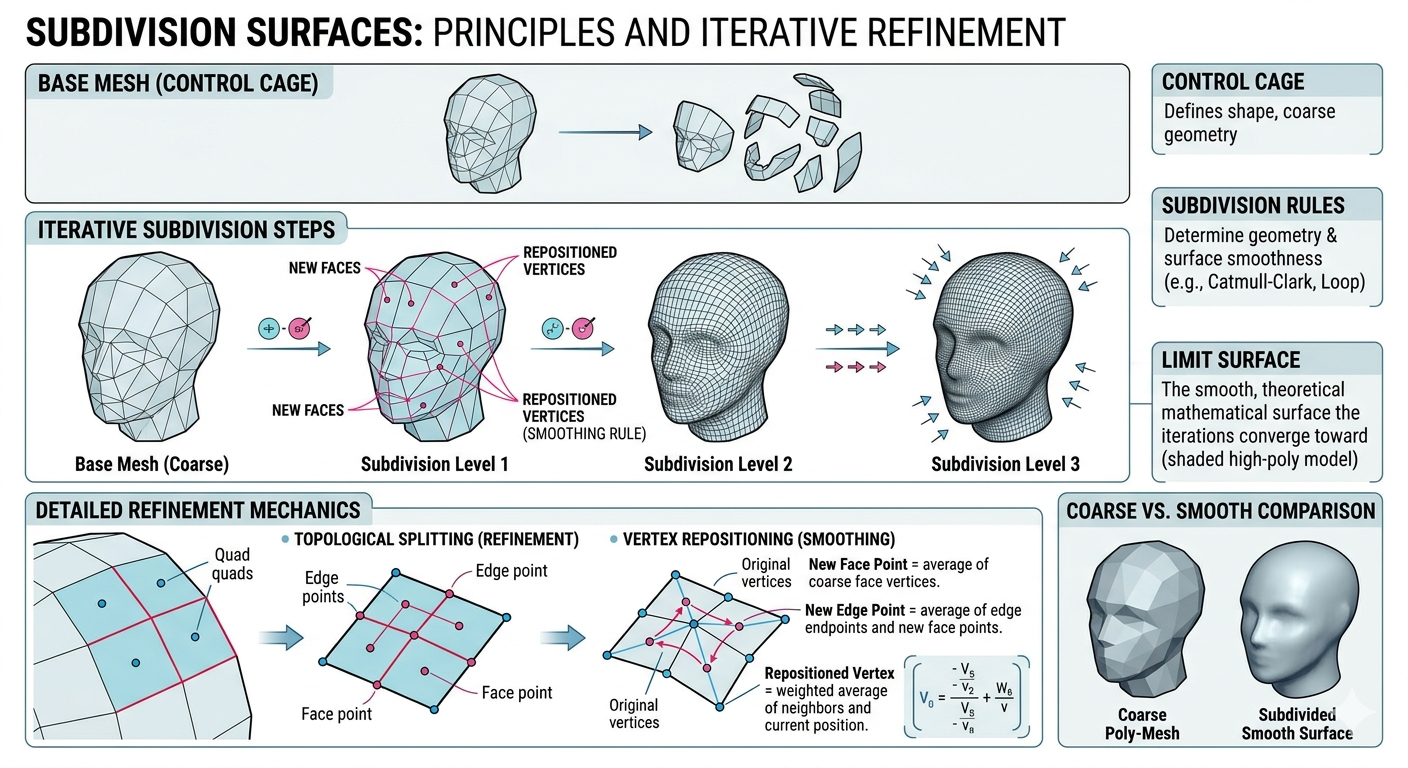
Gemini tries to explain subdivision in one diagram. You can get a sense of starting with a mesh and then having each iteration become smoother. With most subdivision schemes, the surface becomes completely smooth in the limit. Made by Gemini.
- Generalized Cylinders extend the concept of a basic cylinder. You can think of a normal cylinder as a tube created around a line segment. A generalized cylinder allows the tube to follow an arbitrary curve. Three.js has a
TubeGeometrythat allows making a cylinder that follows a Catmull-Rom spline path. (Tube Geometry Docs)
An explanation of generalized cylinders. Made by Gemini.
- Sweeps extend generalized cylinders so that the cross section can be more complicated than a circle. Three.js has these built in as well.
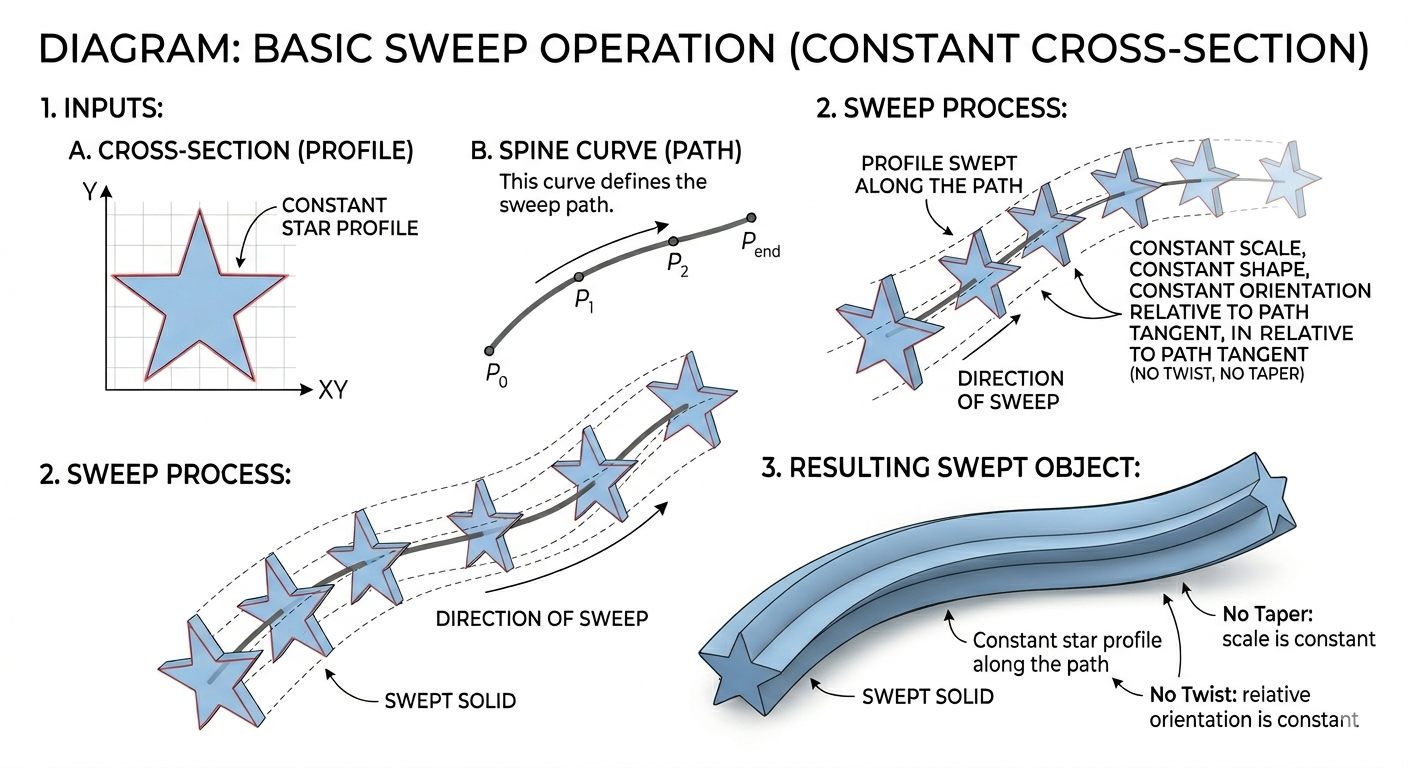
An explanation of sweep surfaces. Made by Gemini.
OK, that was no substitute for learning about geometry. But hopefully, you are at least aware of the concepts. You can try these things out within your Graphics Town.
Next: Page 6 - Graphics Town