We
had a wonderful journey. It broadened
our views and we learned to better appreciate the rich history and cultures of Europe. It was great to see our friend Sandra, and it was
a lot of fun to observe (and practice at times, especially food) local customs.
Writing
this journal was also a rewarding experience.
It was like reliving the journey and helped to crystallize the
highlights along the way. Joe is the
main author on the first half of this journal and Min is the main author on the
second half (Ulm
and beyond). A few of our highlights
were:
St. Germaine area (gallery district and Marche de Buci) and Rodan
Garden in Paris,
our tour of Ulm, hiking near Neuschwanstein
castle, and of course the many museums (Musee d’Orsee in Paris
won our first place vote).
We
have included a few thumbnails with each day’s journey.
More
Pictures at: [Munich] [Paris & Versailles] [Brussels] [Ulm] [Heidelberg] [Neuschwanstein]
We
arrived in Munich
around 9:30 in the morning. The airport
is about 30 km from downtown Munich
but the well-planned transportation system makes this an easy trip. It was a chilly (30° F) overcast day with
patches of snow on the ground. It
reminded us of early springtime in Wisconsin. Our first destination was the central Hauptbahnhof (train station), the place where most visitors
go to take care of travel and lodging plans. We booked train tickets to Paris for Friday night,
and then located a nearby hostel via the tourist information office. After checking in at the European Youth
Hostel, a convenient two blocks from the train station, we packed a backpack
with maps and food and set out to explore the downtown area. We did little else aside from orienting
ourselves and picking up some food from a grocer we happened to stumble into by
chance. Jet lag was taking its toll on
us so we settled into bed around 6 pm.
Notes:
- Smoking in public areas is still common in Germany. Even the airport was full of clouds of
smoke.
- People in Munich
have a very characteristic look about them- neatly groomed, thin (compared to
the average American for sure), well-dressed, chiseled faces and very little
racial diversity.
- It’s difficult to find a grocery store in downtown Munich
amid all the high-end clothing stores.
- Browsing a grocery store in a foreign country is an excellent way to learn
foreign language vocabulary and dietary habits.
- Min got hooked on a “German spam sandwich” called Leberkas,
a popular sandwich we saw people eating all times of the day (even as quick
breakfast while walking in the mornings).
It’s made out of a mold of minced pork, beef and liver. “Leber” means
liver, and “Kas” means cheese.
- People rarely greet or acknowledge strangers.
People in Munich
seemed less personable than what we have grown accustomed to.
Friday March 12
Both of us woke up around 5
a.m. after a decent night of catching up on sleep. We anxiously waited for the staff to begin
serving breakfast at 7:00 and were pleasantly
surprised to see the offering. We filled
up on cereal, fresh fruit, bread and jams, yogurt, cold cuts, cheese and juice
(not bad for a youth hostel!). After
breakfast we checked out of our room, leaving some bags in a storage room, and
went out to see as much of Munich as possible before our 9 pm train. It was a cool crisp day with blue skies and
sunshine, a definite improvement over the day before. We walked around the downtown area (Altstadt neighborhood) for about two hours touring the
sites around Karlsplatz, Marienplatz
and Max-Joseph-Platz.
At 10 am we headed to Alte Pinakothek, one of Germany’s
finest art museums. We were impressed
with the size of their collection, including many great pieces by Dutch and
Flemish masters as well as a huge collection of Peter Rubens’ works. We practically had the museum all to
ourselves with the exception of a few young student groups on field trip. Shortly after noon
we made our way to the Viktualienmarkt for
lunch. This outdoor market has a
friendly atmosphere and a great selection of produce, meats, cheese, wines and
restaurant stands. Bratwursts were
grilling and beer was flowing freely.
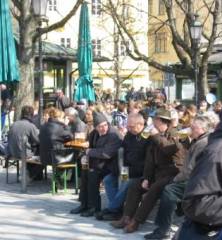
The lunch crowd, young and old, was downing pints of beer at picnic
tables under the sun and we even heard an occasional drinking song. We opted to try pickled herring sandwiches
(not the best decision of the day) and then journeyed over to the Deutsches Museum of Science and Technology around 2
pm. We had a lot of fun with
the hands-on exhibits that were graciously subtitled in English. I picked up a brat at the market for dinner
and Min picked up a breaded turkey sandwich, which we thought was fish
filet. After dinner we did some
window-shopping on Maximilianstrasse and nearby
streets and dropped in on an evening mass at St. Michael’s church. It was then time to head to the train station
for our overnight trip to Paris.
Observations: On a weekday morning in March, many of the
streets in downtown Munich
are eerily empty, a veritable ghost town.
The Viktualienmarkt captures much of the
city’s spirit and is the place to be for lunch.
Residents of Munich
must spend a significant portion of their incomes on clothing; we stood out
like American tourists with our sweatshirts and jeans. Min taught me how to spot a Rubens’ painting
given his use of skin-tones and voluptuous human subjects.
(Min’s add-on) In Munich,
we mostly walked around and took lots of unidentified pictures. It would have been a lot more interesting if
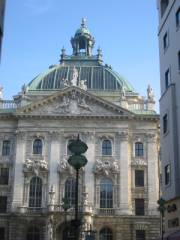
we had known the language and the history better. For example, the famous Residenz
palace now hosts an academy and some museums, but we avoided history museums
since we didn’t know German. There is a Rathaus (townhall) in almost
every German city.
|
|
|
|
Viktualienmarkt beer lunch
|
Residenz Palace
|
|
|
|
|
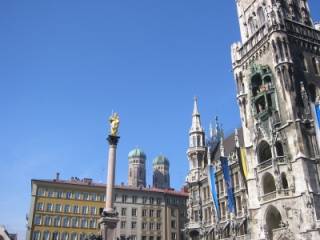
Grand plaza near Viktualienmarkt
|
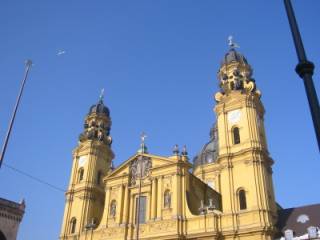
Old Rauthaus
|
We pulled into the train station in Paris
(Nor d’Est) at the precise minute the schedule
indicated, around 7 a.m. The sleeper cabin on the train was nice and
comfortable; we ended up having our own private cabin, as two of the beds were
empty. Less than two minutes after we
stepped off the train a friendly man who immediately pegged us as English
speaking tourists approached us. He
referred us to his employers’ hotel with a “special deal” should we mention his
name at the hotel desk. After hearing
that the hostels in Paris
are less than desirable (according to the desk staff at the Munich
hostel we stayed at) we decided to try this hotel. A quick glance at the subway metro system map
(think spaghetti noodles) influenced our decision to walk to the hotel. A short eight blocks on our map turned into a
45-minute walk with heavy luggage. We
eventually settled into our hotel around 11 a.m.
(we visited a nearby grocery store while waiting for a room to free up). We promptly headed to the prime tourism
magnet, the Eiffel Tower. Lines were long to ascend the tower but we
were determined to take the stair climb as opposed to the elevators. Our first view of Paris
from above was a sufficient reward for climbing the many steps to the top. We then took a leisurely walk on the Trocadero that frames the Palais
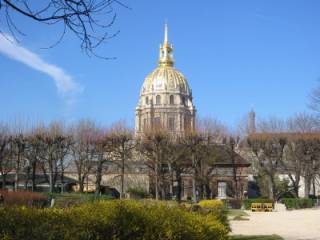
de Chaillot, and then on to Hotel des Invalides (Napoleon’s tomb). We fixed sandwiches for dinner and watched
some French television before bedtime.
Observations:
The punctuality and comfort of European trains is very impressive. Paris
is larger than Munich
(sarcasm intended); objects on the map are much further away than one might
think. Learning the metro system is
essential to getting around in Paris- intimidating at
first but easy to use after a couple runs.
There truly is a bakery on almost every block in Paris. It’s amazing what one can accomplish with a
few small French phrases, hand gestures and a smile J.
Paris is home to all
walks of life, very rich racial diversity and culture.
(Min’s add-on) Walking out of the train station, my
first impression was that it felt very much like the old style Shanghai (my parents
hometown). Along the streets were tall
skinny 6 to 7 story gray buildings with the first floor full of shops and
restaurants and apartments upstairs. The
sidewalks were littered, and the storm sewers had running water to clean the
gutters. Street cleaning workers were
out sweeping streets already. The golden
rays of the morning sunshine skipped through the buildings. Pigeons were out picking on the French bread
crumbs. It all brought back the warm
fuzzy feeling of Shanghai (except the pigeons and
bread part, because all birds are a delicacy in China and people would only save
the bread for themselves).
Another first impression was that beautiful architectural structures were
everywhere. On our “short 8 block walk”,
we saw quite a few historical landmarks.
|
|

|
|
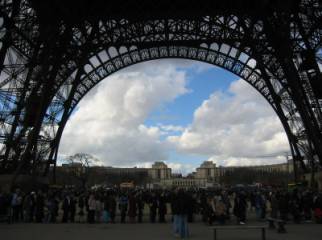
Sky under Eiffel Tower
|
Climbing the Eiffel tower
|
|
|
|
|
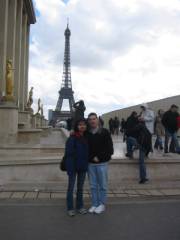
First
view of Eiffel coming from subway
|
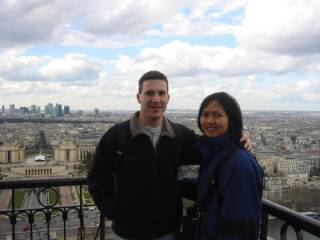
View from top of Eiffel
|
|
|
|
|
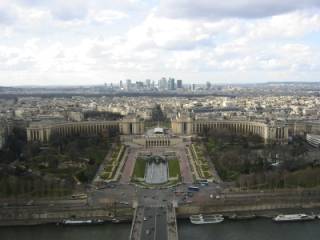
Trocadero
from top of Eiffel tower
|
Napoleon’s Tomb
|
Sunday March 14
This
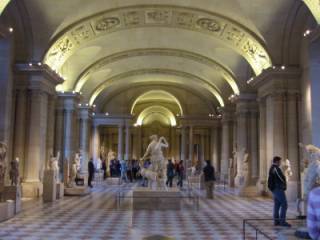
was the day we set aside to visit the Musee Du Louvre. My first impression… Wow! It is difficult to put into words the sheer
magnitude and grandeur of this museum.
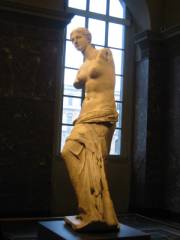
Around every corner awaits legendary works of art such as Venus de Milo
or Mona Lisa, and many antiquities that I first encountered in history books as
a child. I’ll leave plenty of room here
for Min to elaborate. We took a guided
tour in English, which was quite useful to get us warmed up to the
surroundings. After spending a good part
of the day in the Louvre, we then visited the Grand Palais and the Royal Opera House. We shared a banana crepe (yum!) and crossed
the Seine in search of
St. Germain de Pres, a church with much history. Our
walk took us through an art gallery district and then onto Marche
Buci, a French food market that is a short but sweet
block full of street cafes and food stands.
This market had a delightful atmosphere about it; we stopped to watch a
street entertainer while a 4-piece drum and brass band played in the background. St. Germain is a
fine example of Gothic architecture (dates back to 6th century) and
was well worth the visit.
Observations: A visit to the Louvre
is an experience of a lifetime.
(Min’s
add-on)
-“Mona Lisa” is way over-rated. Flashes
and clicks went on continuously in front of the painting even though flashes
supposedly are not allowed. You’d have
to fight through a mob to get a close-up, but the painting was under glass, and
the colors were quite dark looking like it needed some restoration work. Its over commercial
use (just look at how many places we’ve used it, from postcards to parodies)
had turned a fine art piece into an icon.
I wondered what people saw in the piece, or if they even tried to think. Many were too occupied with getting the “me
in front of Mona picture”.
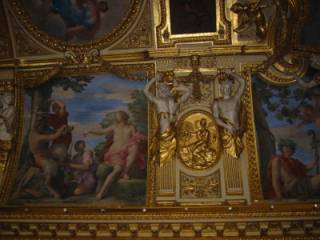
- It was very nice to hear about the history of the palace. I loved hearing about the allegories and
depictions of the frescos and statues on the walls. Another thing added to my To-do list was to
learn more about Greek mythology.
- It was needless to say that I was so moved to see all the great pieces for
real. It was an overwhelming feeling
that engulfed me. It still felt surreal
that I was seeing all these original masterpieces. I remembered how much time I spent trying to
capture the expression of “Madonna of the Rocks” and now I was seeing every
stroke of her smile. I remembered the
familiar pieces that first interested me in western art when I was young.
- I found some new artists I like (well, famous artists I didn’t know
rather). I liked David Teniers’s paintings.
He had quite a few scenes depicting peasant life in action. His colors were earthy and bright, had a calm
feeling to it, while the scenes were lively and in action.
- Across the Seine, the art gallery district
and the Marche de Buci were
very characteristic. I couldn’t believe
there was such a long street full of galleries.
It was like Alice
discovering wonderland for artists.
Unfortunately they were all closed on Sunday eve, but the window watching
was still neat. We loved the Buci. It had a life
of its own. It was very relaxing and
unique. A French father bought his two
kids a chocolate sauce crepe. We watched
the kids standing on their toes watching the crepe maker through the glass, almost
drooling; we watched the crepe maker making the kids laugh, and at the end
handed them the split half crepe each wrapped in paper cones like a magician
pulling a rabbit out of thin air. We
watched a street entertainer mimicking and mocking by-passers and picking out
assistants from an outdoor café.
- We wish we had taken a lot more pictures this day!
|
|
|
|
|
Louvre allegories
|
Venus
de Milo
|
|
|
|
|
|
Louvre antechamber
|
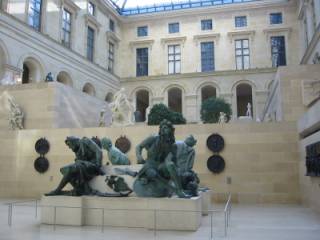
Italian Sculpture Hall at the Louvre
|
Monday March 15
Today
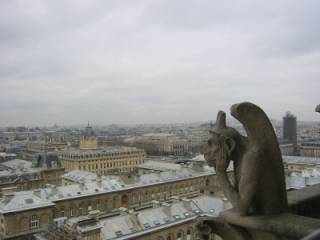
we initiated our 3-day museum pass with a visit to Notre Dame. The long spiral staircase leads to a
fairy-tale view of Parisian rooftops, with the famous gargoyles casting a
watchful eye over the city. Next we
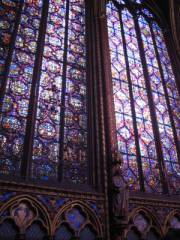
visited St. Chapelle, which was once rumored to house
artifacts from the crucifixion of Christ.
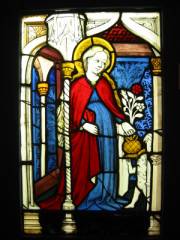
One look at the stained glass windows here and it is easy to understand
why the French liken the ruby-red color of a fine wine to the windows of this
church. The neighboring building complex
contains the Department of Justice and the Conciergerie,
a building that is in stark contrast to the warmth of St. Chapelle. The Conciergerie is
an infamous prison dating back to the times of the French Revolution and is
perhaps best known as the place where Queen Mary Antoinette spent her final
days before being judged a traitor and ultimately beheaded. After a quick picnic lunch we ventured to the
Cluny
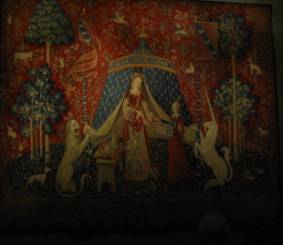
museum to see their collection of medieval artifacts. We were most impressed with a collection of
tapestries known as the “Unicorn tapestries”.
The tapestries artfully and creatively depict human senses and hint at
the key to spiritual enlightenment. Our
subsequent walk towards the Pantheon led us through the Latin Quarter, named as
such because students from nearby University
of Paris once conversed
in Latin in the neighborhood cafés. The
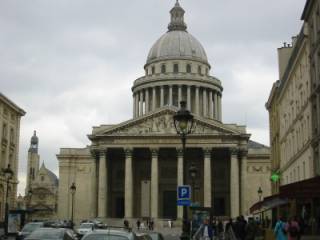
Pantheon was built to honor famous French characters, such as Victor Hugo, many
of whom are buried in the catacombs below.
The catacombs are cold and somewhat dreary, as one might expect, and
were not interesting to us because of our limited knowledge of French
history. Late afternoon found us at the
Picasso museum, a nice collection spanning the entire spectrum of his career. Our last stop for the day was the Pompidou Center to check out the National Museum
of modern Art. This museum takes art
forms to an entirely new level- let your imagination run wild.
Observations: If you’re planning a visit to Paris,
I strongly recommend investing in a museum pass (1, 3 or 5 day). With 70 museums to choose from, it’s well
worth it.
(Min’s
add-on):
We had nice surprises today: places we didn’t know what to expect all exceeded
our expectations.
- We debated about visiting the Conciergerie but went
there out of geographical convenience.
We followed the self-guided tour at the Conciergerie,
read everything in English, and learned quite a bit of French history. We liked it very much. Walking out of the place, I was compelled to
learn more about French history.
- Before this day I had a negative attitude towards Picasso, but visiting his
museum reversed my opinion. I learned
Picasso had a variety of styles, experimented with a variety of media and even
did sculpture.
-Another thought on contemporary art.
Why is abstract art not readily accepted by the general public as
compared to the old masters? I came to some reasoning during the
trip. I believe that many mediocre or
worse works proclaim themselves art are merely means to express oneself without
the rigor of making it art. An art
piece, especially abstract ones, are supposed to make you think, and further
more, require the artist to think more as well as Alan (my art teacher) pointed
out once. It is also the thinking part
that makes abstract art harder to be appreciated than the traditional more
realistic ones. I tried to look hard at
the pieces in Pompidou. To my own
surprise, I found many pieces I liked.
There were many clever and original ideas. For example, one piece was a short black and
white film clip about taking a photo of a group of African kids. It started with a picture perfect cute group
of kids tall and short ranging from toddler to young teenagers with big
smiles. It then skips to shots of the
behind the scene progression: two of the boys started out playfully hitting
each other and then got into a fight, the toddler in front started walking
around mimicking the elders. All played
out in the soothing sounds of the rainforest.
It conveyed the warmth and genuine playful nature of the kids without a
word. Another reason for the reluctance
of the public acceptance I think is that we are used to view art from the
decorative perspective: is it going to look good hanging in my living room? It is no longer a religion
propaganda or decorative craft, but a free means of expression. Today’s technology has opened art to a much
bigger variety of media. Maybe like the
days of the initial rejection of the impressionism, some contemporary art will
have a warmer reception tomorrow. It is
also interesting to see that today the expression is so individualistic that we no longer see
schools of styles but rather individual styles, or periods of an individual’s
style.
|
|
|
|
A
Notre Dame gargoyle looking over the city
|
St.
Chapelle stained glass
|
|
|
|
|
Pantheon
|
One
of Unicorn tapestries
|
|
|
|
|
Stained
glass at the Cluny
museum
|
Spring
flowers in a Paris
park
|
|
|
|
|
Pomidou
|
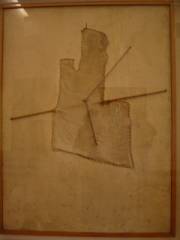
Picasso’s
Guitar
|
|
|
|
|
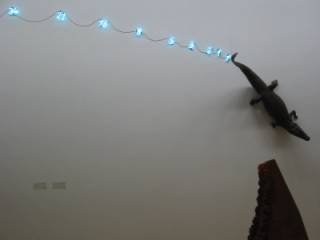
Gator
spitting Fabinacci numbers
|
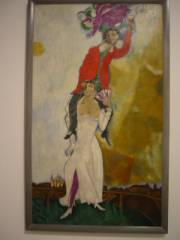
Groom
on the shoulders of his bride
|
Tuesday March 16
Definitely
the best weather we could have imagined on this day, more like May than
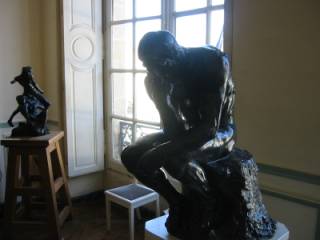
March. We began with a trip to Rodin’s museum, a wonderful collection of his work. Many of his works are displayed in an outdoor
garden, which was a nice way for us to soak up the morning sunshine. Although Rodin is
best known for pieces such as “The Thinker”, he created literally dozens of
equally if not more impressive works- he must have been a busy person. Mid morning we headed to Musee
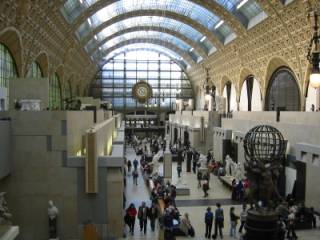
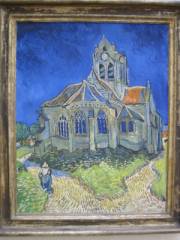
d’Orsay. The Orsay was my favorite museum of the trip, which says a
lot. I was really moved by the
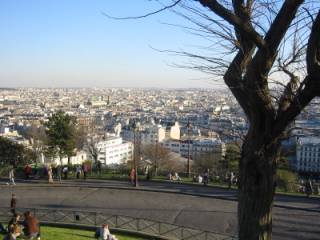
Impressionist collection, more than I could have imagined. In the late afternoon we decided to head to Sacre-Coeur (sacred heart).
The crypt contains a relic of what some believe is a piece of Christ’s
heart, hence the name. This monument is
certainly the crown jewel of the Montmartre
District. This is the highest point in Paris,
and the view can extend for 35 miles on a clear day- we were lucky to visit it
on a very clear day. Min burned a candle
in homage to Mary of the Immaculate Metal.
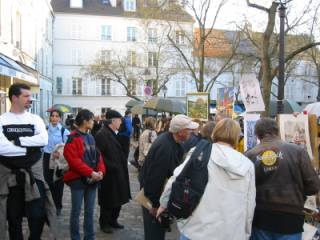
The district is also home to a permanent artist fair, which is no doubt
drawn to the scenic panorama and Sacre-Coeur. After this we headed back to our hotel and
picked up a rotisserie chicken at a restaurant that had been calling our name
for several days. We had a tasty feast.
(Min’s
add-on):
-Rodin’s sculpture garden and the museum were most
inspiring. Many young artists stood
around with sketchbooks. I would be
content staying there for months just to sketch the statues. Long after the trip, the first image come to
mind considering my jealousy towards the Parisians was the sight of people
sketching at the Rodin museum. Rodin’s figures
were full of intensity, from their twisted poses, to the concentration in the
eyes, to every muscle and vein. The
sculptures were alive, so powerful, instilled with the artist’s spirit. Many figures were in their own serious
contemplation; I wondered what went though the artist’s mind. Another item added to my To-do list: read up
on Rodin.
-I had wondered why many prefer landscape to figure paintings. I started out that way too until Alan led me
into figure painting. I now found people
painting more intriguing, as it seemed more dynamic and intimate. I think the traditional values and
self-consciousness have often told us to shy away from seeing the beauty in
human bodies. Like a tree or a moutain, poses we make can be just as beautiful as a
landscape composition. Like the
impressionists trying to capture the ever-changing light, figure artists try to
capture the action or expression of the moment.
Looking into a portrait’s eyes or smile often leads to deeper thoughts
than the pure appreciation of natural beauty.
- Musee d’Orsee was our favorite
museum. I loved its architecture: it was
a most perfect blend of traditional and modern architecture I’ve seen. We loved the collections and it was not as
overwhelming as the Louvre.
|
|
|
|
Rodin’s Thinker
|
Musee d’Orsee
|
|
|

|
|
Van
Gogh
|
Sacre-Coeur
|
|
|
|
|
Paris from Sacre Coeur
|
Art
market near Sacre Coeur
|
Wednesday
March 17
Having exhausted our priority site seeing list
in Paris,
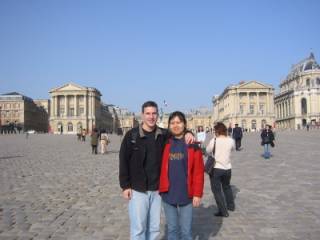
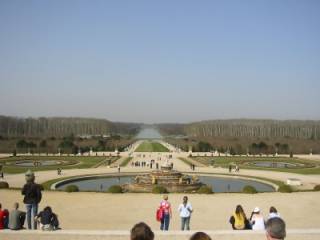
we took a 20-minute train ride out of town to visit Versailles. We toured the Grand Apartment (also covered
by museum pass) and the gardens. While
the royals were living at this estate in grandiose fashion, a revolt was
brewing. The history was quite
interesting and the surroundings were certainly among the worlds most lavish at
the time. We completed our tour by lunch
and returned to the city. The Museum of Science
and Industry was a learning experience, though it did not cater well to
non-French speakers. We then visited the
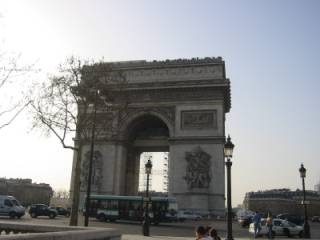
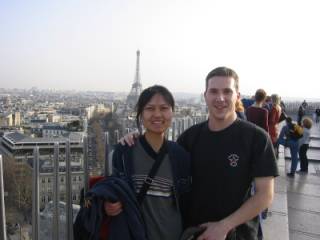
Arch de Triumph, the site of many of France’s
proudest victory celebrations as well as one of the countries most humiliating
moments when Nazi troops paraded under the arch. Our last stop of this leg of the trip was a
return visit to the Louvre. After all of the time we spent here, it still
feels like we’ve only seen the tip of the iceberg.
(Min’s
add-on):
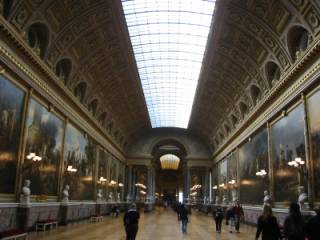
-Versailles’s
Hall of mirrors was most spectacular: 120 meter long with 34 spectacular battle
scenes in French history on the walls.
- The palace construction started by Louis XIV in mid 1600’s. The extravagancy continued by his successor,
and was looted during the French revolution in late 1700’s.
|
|
|
|
In
front of Versaille
|
Versaille Hall of Mirrors Famous Battles
|
|
|
|
|
Gardens
of Versaille
|
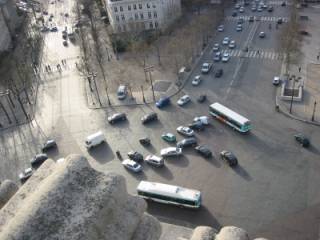
8
lane traffic around Arc de Triumph
|
|
|
|
|
Arc
de Triumph
|
View
from top of Arc de Triumph
|
We
checked out of our hotel in Paris
and took an 8:30 train bound to Brussels. We arrived in Brussels
around 10 am. The high-speed trains are a modern day
marvel. We left most of our luggage in a
locker at the train station and eventually found our way to the central market
area where the tourism office is located.
The tourism office in Brussels
is very well organized and business-like, they do 99% of the lodging
reservation work for you, all you have to do is show
up at your chosen destination within the daily booking period. We found out that all of the hotels were
completely booked up due to an EU conference and World Game events so we ended
up reserving a couple beds in a hostel.
The subway system in Brussels
only consists of a few routes so it was quite friendly to visitors. After claiming a couple of beds in a 12
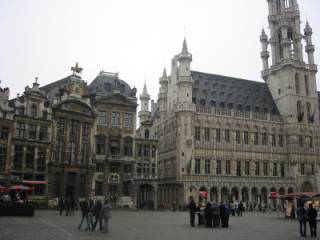
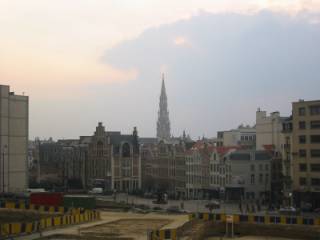
person room, we headed back downtown to the central market area. The architecture and urban design of
buildings in the city core of Brussels are very
reminiscent of Paris,
albeit on a smaller scale. For example,
it appears that the residential buildings in Brussels have a standard size of five floors compared
to the seven-story Parisian standard.
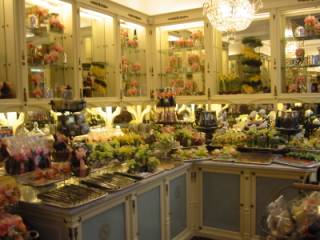
Our shopping led us into a very elegant teashop. After a game of charades (the store keeper
only spoke French) and a great deal of sampling the scents, we left with an
interesting collection of tea blends. Min
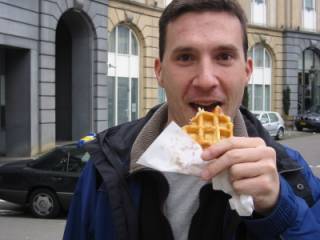
and I shared a very tasty waffle, one of the most popular snack foods you will
find in the streets of Brussels. We walked all over the downtown area. One of the most intriguing parts of town is
the restaurant district near central market.
Most of the restaurants have outdoor tables and the maître
d' actively try to recruit patrons off the street. It was kind of fun to listen to their sales
pitches as they tried to woo you into their restaurants; most of the maître d' were quite charming. We ate a picnic lunch in a nice park near the
Royal Palace.
While we ate we watched international athletes jog around the park in
training for their events, they all wore outfits representing their
countries. Min spoke briefly with a member
of team China
and learned that the athletes were competing for a World Games Track and Field
Event in the upcoming days. After the
park we made our way back to the hostel and Min decided to head to bed early. She was coming down with a cold and was
feeling a bit worn down. I returned
downtown to explore the central market area.
The streets were full of people and the night-lights seemed to bring the
city to life.
|
|
|
|
Famous
Waffle de Liege
|
Chocolate
shops fancier than floral shops
|
|
|
|
|
Grand
market
|
Downtown
|
Friday March
19
We checked out of Brussels and took a 10
a.m. train bound for Amsterdam. Even though the distance between Brussels and Amsterdam is
less than the distance between Paris and Brussels, we quickly learned
that not all trains are created equal.
The same distance that took us 1.5 hours the day before, took us more
than 4 hours on this day. We arrived in Amsterdam around 2 pm. It was a cold rainy day with high winds. Going against our instincts, we decided to
pack a bag and set out to explore the city.
The train station is located in the heart of the Red light district- my
first impression of the area was that the city had sold its soul in order to
become a cheap, sleazy version of Las
Vegas. We both
felt like we had to keep a close eye on our belongings, which probably had
something to do with the many shady looking characters that hung out around the
casinos and clubs. When we got to the
outer edge of the Red light district and entered into what appeared to be a
University District, it was as if we had walked into a completely different
town. We got a glimpse of the rich
history behind the city and began to see where and how the locals resided. We arrived at a museum of interest around
4:30, only to find out that it closes at 5:00 and doesn’t give admission
discounts to late-comers. We decided
just to head back to the train station (about 2.5 miles) and cut our losses
while waiting for our evening train to Germany. Right after we left the museum it began to
rain very hard and the wind was tearing peoples’ umbrellas to pieces. We got completely soaked and ended up
spending our last 3 hours in a Burger King at the train station in an effort to
warm up and dry off. Every vacation has a low point; this day was our low
point. The weather definitely tainted
our impression of Amsterdam
but it is still safe to say that we are not planning a return trip to this
city. The best part of the day was when
we dried off, changed into clean clothes and settled into comfortable reclining
chairs on the sleeper train.
We
arrived in Ulm
bright and early before 7 a.m. and found my friend Sandra’s place no
problem. We got fresh breads and goodies
from the bakery and went in town soon after shower and breakfast. I got hooked on Nutella
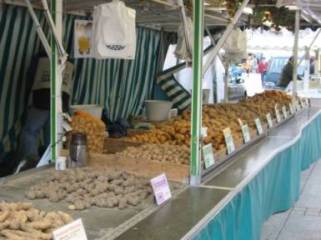
(a hazelnut chocolate spread, used in crepes, bread, anything). There was a large farmers market on
Saturdays; many locals get their grocery here.
It was packed with people, and Sandra ran into a few familiar faces. One potato stand had more than ten varieties
of potatoes, including purple ones.
Sandra then gave us a tour of the town.
Ulm is
famous for it being the birthplace of Einstein and having the tallest Church
steeple in the world. Ulm is a quaint port city sitting at the
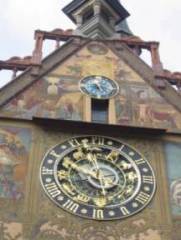
intersection of three rivers. The Rathaus had an impressive astronomical clock made in
1500’s, all mechanical, and tells you everything with rings of dials (eclipses,
tides, etc). The hotel “Crooked house”
is a natural attraction. The house leans
naturally toward the river. All frames
of reference are equal, so instead of fixing the global reference (building),
the hotel elected to fix the local coordinates (the furniture): for example the
beds have legs longer on one side.
Except if you push an orange from one side of the room, it always rolls
in a particular direction… We walked
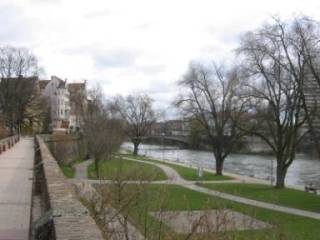
along the rivers more, and heard more stories about the town.
“The Flying Taylor of Ulm”. Legend has it an Ulm tailor was among the first to devise a
flying machine in the early 1800’s. On
the day the tailor was going to demonstrate it to the king, it turns out the
king was too fat to get to the hill where the tailor practiced so they changed
the flying course to be across the river.
The wind current was different and the tailor fell in the river. Nowadays the town holds an annual flying
competition (human powered) to see who can fly across the Danube
river which is a water fight fest in disguise.
There are only one or two that make it across every year.
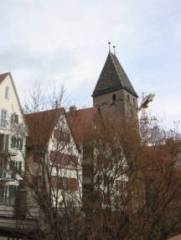
“The Butcher’s tower”.
Legend has it during a poor economy time, one butcher stuffed oatmeal in
his sausages and profited from it. When
the trick was discovered, he was locked in a tower and he was so fat that the
tower bended one way.
Trading recipes was an important ritual between Sandra and I. We found a small Asian grocery in town. I showed her how to make Chinese steamed bun
and Vietnamese spring rolls. We had to
improvise the steamer and the flour wasn’t right (only had Thai on it), but she
got the legist of it. We took an
afternoon nap afterwards while Sandra made 2 apple
pies for the party we were going to tonight.
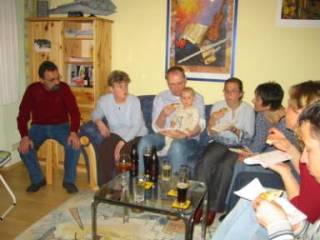
It was Sandra’s good friend Regina’s
birthday today. We hopped on a train and
got there in half an hour. It was very
nice to get to know Sandra’s friends a bit and get a taste of the locals’
lives. I understood why Sandra was
attached to this place now. They were
very friendly people. Joe liked the
wheat beer they introduced to him (Hefeweizen).
|
|
|
|
Rathaus Astronomical Clock
|
Potato
stand at Saturday market
|
|
|
|
|
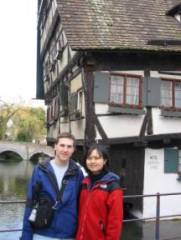
Crooked
house
|
Danube River
|
|
|
|
|
Butcher’s
tower
|
Regina Party
|
Observations:
- The German bus system was very convenient. The buses ran frequently (even
on a Saturday morning or late Friday night).
The connection times were well planed and the buses wait for each other
at connection points. The buses were
much more modern: equipped with automated next stop announcer and display,
automated ticket credit swipe boxes.
- It was interesting to observe a crowd converse in a complete foreign
language. You could actually decipher
quite a bit from gestures and some context help. If you were totally lost, studying the
personalities by watching people talk was also interesting.
- Europeans seemed to travel a lot. They
often had 6 weeks of vacation. Regina had pictures of
many places all over the walls. She’s
going to visit the States soon. One guy at the party was fascinated with Egypt (been
there 19 times), so we heard a lot about his adventures.
- Germans were very conscientious about conserving resources. People usually brought their own baskets or
bags to shopping. There were highly
developed recycling programs even in smaller city like Ulm.
On
German people:
Aside from the first day Munich impression of
the dressy and sternness, we got to know a little more about the people through
our 4 day Ulm
stay.
The Germans were very principled people.
What’s most impressive about the bus system was that it’s run on a
voluntary base: nobody checks for tickets.
There is a fine if one was found “riding black”, and there were
undercover polices that randomly checked for tickets. Sandra said during her 1.5 year stay, she had
only been checked twice. Statistics showed
more than 85% riders ride legitimately.
I expect the number to be much lower in many other cultures. During our 5 days of subway tunnel in Paris, we saw two
incidents of people jumping over the ticketing fence bar right under the
ticketing window employee’s eyes to get a free ride. At crosswalks, most people waited for the
green walking light; this was quite different from Amsterdam and many cities in the States. No wonder they say there is a policeman in
every German.
The Germans were not as physically touchy as the French: they shook hands
mostly. But they were wonderfully warm
and nice people like others as we observed at Regina’s party and heard Sandra’s stories.
They were very punctual and methodical.
The bus were always on time, so were most
people going to parties. I could see how
this trait could help with a country’s development at a larger scale.
We
hopped on the train headed to Heidelberg
today. It’s about two hours from Ulm by train. Sandra went to visit a friend there for a
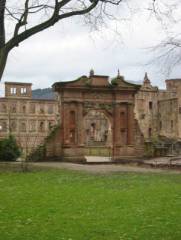
birthday brunch, while we visited the Schloss (Castle
in German). The city was one of the few
that were not bombarded in WWII, and the castle ruins were spectacular. The red stoned ruins situated in the midst of
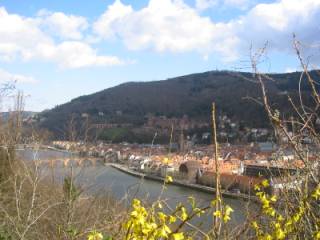
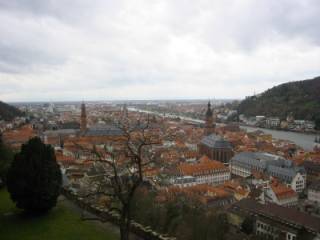
the mountain greens in the middle of a hill. It overlooked the city below by
the Neckar river. We walked all
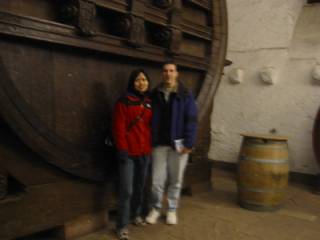
around it and visited the Pharmacy museum inside of it. The architecture was grand. They had a couple of wine vats. One was the world’s largest in the castle
(too dark to take a picture though). The
huge barrel like container built in 1751 held 200K liters of wine! We met up with Sandra at the downtown plaza
at 2pm, and headed to the
other side of the river for a little hike up the Philosophenweg
(“Philosophers Walk”). It’s a winding
path on the hill across the river. It
gave the best overall view from there, especially as we had a sunny day. We then walked back to downtown Heidelberg. They had the longest pedestrian walk
downtown, with all kinds of shops flanking the walk (The mall is closed to
traffic). We had an early dinner at an
authentic German restaurant there. We
headed home afterwards and Sandra taught me how to make “Spatzle”.
Observations:
- On the long train ride, we learned about Sandra’s research project a bit
more. She’s doing modeling of the bone
fracture and healing. It was very
interesting to see how different disciplines came together: Bio-medics used
computer modeling. What she was trying
to solve were analogous to the computer graphics modeling and constraint
solving problems.
- On our way down from the Philosophenweg, we saw
bikers, young and old, in simple street bikes, enjoying this sunny spring
day. Here, bicycling as a sport was seen
more as a leisure activity that all ages participates
rather than the full-geared hardcore bikers in the States. Still on the walk to the restaurant, we saw
the downtown was packed with all the locals.
We were surprised to see so many people were out, doing just walking;
most stores close on Sundays (even grocery) in Europe. The strollers were out, the street artists
were out, and the locals were leisurely window-shopping in the sun. Walking was a common Sunday afternoon
activity. It was a very warm relaxing
scene. One could feel the slow down of
life pace at those footsteps.
- I always have to detail about food:
Dinner:
Joe had Pfalzer Saumagen:
stuffed pork patties (looked like some sort of ham, supposed to be stuffed pork
belly), with fried potato and sauerkraut.
The meat patties were tasty.
Min: Weisswurst with breadpreztel
and special mustard. Weisswurst
(white sausage) was made of veal, calf brains and spleen. It tasted like hot dog, but a little
bland. I read later that Germans often
had Weisswurst for breakfast with beer. I thought Chinese ate a lot of animal
internal parts, now I learned Germans do no less: there were dishes made out of
pig knuckles, calf’s tongue, etc.
Sandra: chicken salad, she’s excused since she’s tried most of the German
specials.
Spatzle:
The German “mac and cheese”. It’s a quick homemade pasta dish. The batter consists of about 3/4C flour, 1
egg, salt and pepper, and enough water to make it pancake batter
consistency. Mix and let the batter sit
for ten minutes, and then put it through the “Spatzle
press” (a grater looking gadget) over a pot of boiling water. Layer the hot pasta with cheese and you’ve
got it made! The fresh pasta had the
perfect tender and chewy texture.
|
|
|
|
Heidelberg castle
|
Heidelberg from Philosophenweg
|
|
|

|
|
The
second largest beer keg in the building
|
Saumagen and Weisswurst dinner
|
|
|
|
|
View of Heidelberg and Nektar
River
|
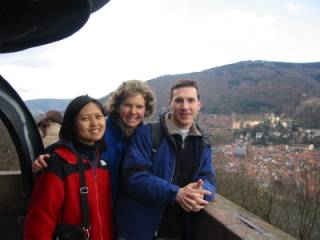
Watchtower overlooking town
|
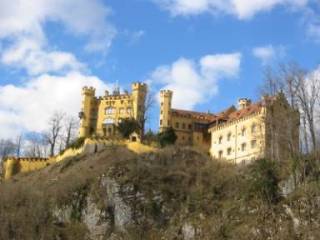
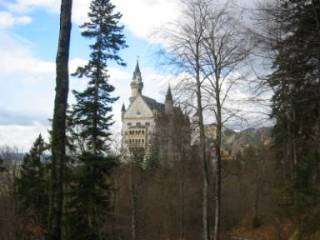
A field trip day to the Schloss Neuschwanstein and Hohenschwangau
(castles). We took the 10am
train, with a couple of train transfers, arrived Füssen
(the castle town) after 1pm. Neuschwanstein was the fairytale castle of “Mad” King
Ludwig II built for himself in late 1800’s.
The Disneyland castle was modeled after
this. Hohenschwangau
was the one Ludwig grew up in on the mountain across Neuschwanstein. Ludwig’s extravagancy (he built 2 other
castles besides Neuschwanstein) eventually brought
him the diagnosis of “mentally unfit to rule”, and led to his mysterious death
the day after he was officially removed from power. We hiked up to Neuschwanstein
in 20 minutes and waited around for our 2:30 castle interior tour. The tour forbade photos because all the
furnishing was original. We learned
during the tour, the throne room floor had 2 million mosaic
which took 4 years to complete. The
chandelier held hundreds of candles. The
bedroom had the very elaborate wood carving on the bed canopy, which took 4.5
years to complete. Ludwig stayed at the
castle for a total of 129 days, and his longest stay was 12 days straight. The king loved Wagner’s operas, so he built a
Singer’s Hall occupying the entire forth floor.
Our tour guide was a very stern looking young German fellow named
Klaus. He rarely smiled; we had
initially thought he was just looking bored with his job. But we soon learned his warm caring
side. There was a blind man in the
group, and once he learned that, he paid special attention to the blind man,
stayed close to him, led him to touch things and explain more details.
There was a Marienbruicke (Marien
bridge) 10 minutes across the mountain that’s supposed
to give the best view of the castle. But
because it was still the winter season, the short route was closed. We had to walk all the way downhill and then
up the next hill to the bridge. It was
3:30 by the time we started going up the hill, and to catch the 5pm train home,
we had to do an uphill running workout.
The view proved worthy of the run.
Observations:
- Today was more of a nature sight seeing day.
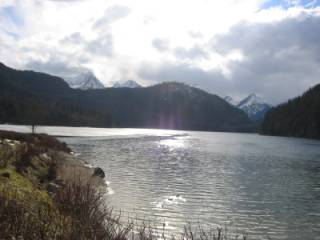
It was cool and crisp with snow patches still in the mountains. Hiking in the alpines was quite a treat. The smell of the pines was refreshing. The lake at the foot of the hill sparkled
beautifully under the sunset. The sight
of the green fields and the red roofed German towns was even more
inviting. Being there brought us closer
to understanding old masters like Corot, Sisley, Pissaro’s paintings and
their states of mind.
|
|
|
|
Hohenschwangau
|
Neuschwanstein
|
|
|
|
|
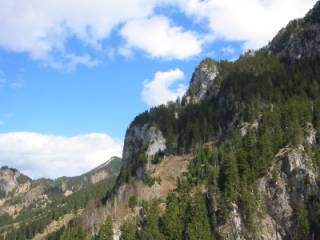
Mountains
overlooking Neuschwanstein
|
Alpine
lake (looking towards Austria
border)
|
Tuesday March
23
A laidback day. I woke up before 4am coughing badly. I laid in bed until
after 7, but still wasn’t feeling great.
We bummed around the house and took care of the chores first: packed up,
tidied up the rooms, and shopped at the supermarket and the bakery. We got our “Spatzle
Press”, some German wheat beers, and a few items to stock up Sandra’s
place. We then headed out to meet Sandra
for lunch at her work. Her biomedical
research institute used the medical school cafeteria (better food). We had delicious hot entrees. Sandra then showed us her office and labs a
little. We saw fresh human bones lying
on the stress test table. Joe and I then
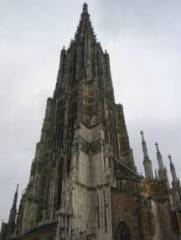
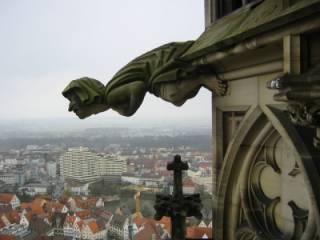
headed to climb the tallest church steeple in the world, the Ulm Munster. It had 780 stairs. It was very cold and windy on top, but gave a
nice view of the city (would have been better if it was sunny). The dizziness from the narrow spiral stairs,
combined with the headache and tiredness, I was feeling pretty sick coming out
of the place. We went back home for a
nap. I was finally able to get a little
sleep before we headed out again at 4:30.
We met Sandra and her friend Titus at the train station and headed to an
Egyptian vegetarian restaurant for dinner.
Titus, Sandra’s Stanford dorm friend, has been doing day trading. Living
in Germany gives him his
perfect night owl type working-schedule due to the time difference with the New York stock exchange.
We had fun conversations. It was the
best vegetarian restaurant we’ve tried (well, for those who know our eating
habits, we can’t go without meat for more than 3 days, especially me). We headed home pretty early and chatted with
Sandra a bit more before hitting the sack.
Observations:
- Sandra’s research institute has coffee breaks twice a day 9:30 and 3:30. Everybody comes down and socialize during
these breaks. I thought this was a great
way to socialize and relax. We tend to
be so efficient and fast paced that we get stressed out more in the states.
- I enjoyed our chat tonight. Sandra
showed us her picture album, from Alp hikes to Istanbul.
It always amazes me all the adventures she’s taken and be able to excel
at everything she does. It reminds me of
an ideal life I always long for. Of
course I understand these were only imprints of the sunny side of life, and
that leads me to admire her more for her ability and perseverance to get to
where she is now.
More
food detailing:
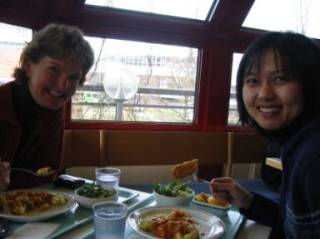
- Lunch: Joe had breaded pork chop with curry’ish
potato salad (very yummy). Sandra and I
had the pasta made of potato dish. It
was the best pasta I’ve had, much softer than normal pasta and had good
texture.
- Dinner: Best drink we’ve had. It’s
made out of some kind of plant powder, milky white,
hot whipped, had a delicious light fragrance, and topped with a few almond
slices and cardamom like spices in the center.
Joe and Titus had a bean dish stewed in tomato sauce (can be easily repro’ed at home).
Sandra and I had a deliciously seasoned rice
with peas and diced veggies dish. The
spices favored the rice just right, tasty but not overpowering. It had tomato sauce in the center, and topped
with crispy fried onions.
|
|
|
|
German
lunch
|
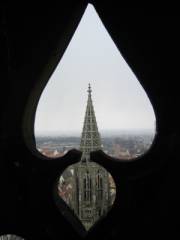
Ulm Mǖnster’s
steeple
|
|
|
|
|
View
while ascending church spire
|
Spire
view of adjoining tower
|
|
|
|
|
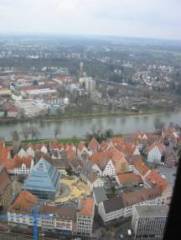
View
of Ulm from top of spire (Mǖnster)
|
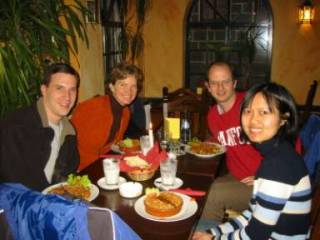
Egyptian
dinner
|
We
took a train to Munich
in the morning for the noon
flight. As we looked out the airport
window, we saw big snowflakes coming down.
Hey, we left at a good time. But
I was getting sentimental already: I was missing all the places and Sandra
already. We saw so much in two weeks. It
was a sensory and emotional overload. We’ll be back some day.
After
the trip:
-I switched to 2% milk because I am addicted to the French’s steamed whole milk
(too bad no daily fresh bread and croissant yet).
-I repro’ed the Spatzle
dish with the “Spatzle Press” we brought back from Germany.
-Hopefully I’ll get to the things I added to my To-do list one by one, and
transfer the inspirations into productive energy.