Back to index
Granularity of Locks and Degrees of Consistency in a Shared Data Base
J. N. Gray, R. A. Lorie, G. R. Putzolu, and I. L. Traiger
IBM Research Lab, San Jose, CA
One-line Summary
Concurrency Control has two parts: hierarchical locking & reduced consistency level.
Overview/Main Points
- Concurrency Control
- Example: x has $100, y has $200
| T1 |
T2 |
| R(x) |
|
| x ← x - 20 |
|
| R(y) |
|
| y ← y + 20 |
|
| W(x) |
|
|
R(x): $80 |
|
R(y): $200 |
|
Total ← x + y: $280 |
|
End |
| W(y) |
|
| End |
|
After T1, X has $80, and y has $220.
- Transaction
- Take db from one consistent state to another (if run by itself)
- Then, any sequence of transaction running serially take the DBMS from one consistent state to another.
- ''seralizable'' means ''look like'' run serially.
- view transactions as series of reads & writes.
- A sequence of xacts
- T1: R(x)
- T2: W(x)
- T3: R(z)
- ...
- What ''forces'' T1 to precede T2? (a list of operations changing the order is consistent)
- R-W conflict
- W-R conflict
- W-W conflict
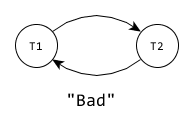
- Serialization Graph
- One node for each xact
- Edge from Ti to Tj if R-W / W-R / W-W conflicts from Ti to Tj
| T1 |
T2 |
| R(x) |
|
| R(y) |
|
| W(x) |
|
|
R(x) |
|
R(y) |
| W(y) |
|
- Theorem
- acyclic serialization graph ⇒ serializable
- a cyclic serialization graph ⇔ conflict serializable
- 2 kinds of lock
- S-lock (read lock): must get an s-lock on an object before reading it
- X-lock (write lock): must get an x-lock on an object before writing it
- 2-phase locking: as soon as the xact releases a lock, it never can acquire another.
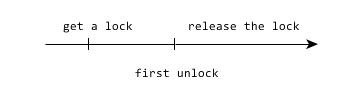
- Theorem: 2-phase locking ⇒ serializable
- T1: sum balances of all records
- Option 1: lock all the records individually
- Option 2: lock the whole file
- T2: update the balances on record, 517,333.
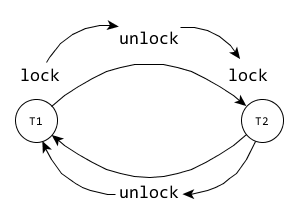
- Granularity (size) options for locking: it is about efficiency (concurrency vs overhead), not consistency
- DB
- Files: a xact that scans all records to compute sum of account balance
- Pages
- Records: a xact that updates the record 509,317 to increase balance
- Notification in a hierarchy manner
- Is there any locks on record in the DB?
- Is there any locks on record in the files?
- Is there any locks on record in the pages?
- Is there any locks on record in the records?
- lock types
- S-lock: implicit set S locks on all descendants of the requested node
- X-lock: implicit set X locks on all descendants of the requested node
- ''intention'' locks
- IS (Intention Share): may convert to S later; allow its descendant nodes to lock in S or IS, but no implicit locking for them
- IX (Intention eXclusive): allow its descendant nodes to lock in any locks (IS, IX, S, SIX, X), but no implicit locking for them
- SIX (S + IX): implicit set S locks on all descendants of the requested node, and allows its descendants to lock in IX, SIX, or X
- A xact that reads an entire subtree and updates particular nodes of that subtree
- Option 1: X at the root of the subtree (low concurrency)
- Option 2: IX at the root of the subtree with individual I, S, and X at the lower nodes (high locking overhead)
- New lock: SIX (allow read without further locking, and write in the subtree by setting X on the updating nodes and IX or SIX on the intervening nodes)
- Xact synchronization
- compatible in terms of two lock requests for the same node by two different xacts
- NL: No Lock/Null mode
- X, S, I are incompatible with one anothter but distinct S requests may be granted together and distint I requests may be granted together.
| Compatible |
NL |
IS |
IX |
S |
SIX |
X |
| NL |
Y |
Y |
Y |
Y |
Y |
Y |
| IS |
Y |
Y |
Y |
Y |
Y |
|
| IX |
Y |
Y |
Y |
|
|
|
| S |
Y |
Y |
|
Y |
|
|
| SIX |
Y |
Y |
|
|
|
|
| X |
Y |
|
|
|
|
|
- Is there anything between chaos of serializability? Yes, optimistic CC.
- Lock manager: maintain a hash table of locks in main memory
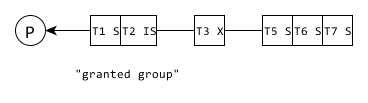
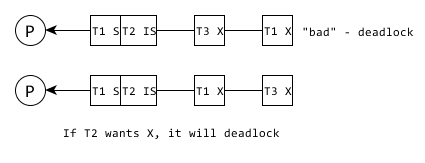
- Lock Conversions: T1 decides to want an X lock on P instead of S
- Deadlock Detection
- build ''waits-for'' graph in the lock manager
- search for cycles
- incrementally whenever a xact waits, update the graph & check for cycles
- break the cycle by picking a ''victim'' to kill
- current blocker
- youngest xact in cycle
- fewest locks held
- random
- minimum work: the xact that has consumed the least amount of resources (e.g., CPU time) so far
- most cycles: the xact that breaks the largest number of cycles simultaneously
- most edges: the xact that eliminates as many edges as possible
- Locks use a lot in serializability
- Lock acquisition
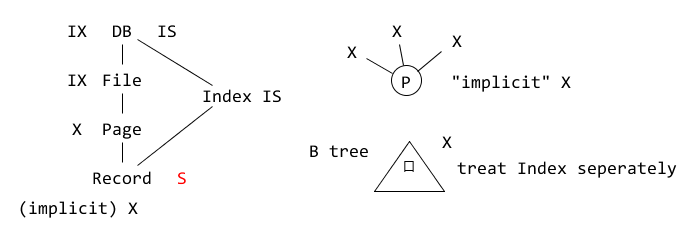
- Before getting an S or IS lock on an object, (explicit or implicit) get S or IS on at least one parent
- Before getting an IX, SIX, or X lock on an object, (explicit or implicit) get X or IX on all parents
- Get locks top-down, release them bottom-up
- Latch VS lock
| Latch |
Lock |
| for consistency: no concurrent updates; mutual exclusion |
for serializability |
| very lightweight (low-level locks) |
"heavier" |
| protest systematics of the system |
protest logic of the system |
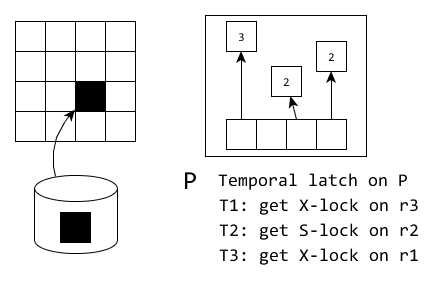
- Mutual exclusion cannot guarrantee serializability
- Every xact can have at most one latch
- DBs
- Relational DB: IBM's System R & DB2
- Structural English QUEry Language (SEQUEL)
- Structural Query Language (SQL)
- UC-Berkeley's Ingres & postgresql
Relevance
Flaws