


The goal in this project is to improve the performance of human operators in tasks that involve motion planning and control of complex objects in environments with obstacles. The human performance in such tasks is known to be patently inferior. Our focus is on developing a visual computer interface that would allow the operator to visualize and perform the work in the task configuration space (C-space) rather than in the work space (W-space) as usually done. To make it feasible, a computer intelligence is provided that works alongside with human intelligence in real time. To this effect, we combine the ``desirable'' features of human and machine intelligence and exploit their individual strengths. This area belongs to the field of human-centered systems, which has seen growing interest in recent years. The intent of this work is to be applicable to many existing research [1] and commercial problems [2, 3].
There is a large and rapidly developing class of technical systems that are dependent on human contribution for their operation. In various teleoperated systems (such as in space, nuclear reactors, chemical cleanup sites, underwater probes) human operators plan and guide the motion of remotely situated devices through interaction with computer displays or three-dimensional models of the device. Familiar examples include control of the NASA Shuttle arm and of the Titanic exploration probe. In such tasks operators are known to make mistakes of overlooking collisions with surrounding objects; this results in expensive repairs and limits the system effectiveness. People seem to be unable to navigate and manipulate remote equipment without colliding with objects in the environment.
Similar problems occur in other settings. Guiding the position of a robotic welding gun or spray painting device with a simultaneous translation and orientation adjustment seems to be particularly difficult for people, even when visual feedback is provided. Performance is very poor in a variety of these movement planning tasks when time is not a constraint (the Shuttle arm, for example); it becomes progressively worse in real-time operation, in three-dimensional (3D) vs 2D tasks, and when system dynamics are involved (masses, inertia etc.). (Underwater exploration probes, for example, cannot stop while the operator considers the next move).
Experiments with human subjects [4, 5] suggest that the problem is in the peculiarities of human spatial reasoning: humans have difficulty handling simultaneous interaction with objects at multiple points of the device's body, or motion that involves mechanical joints (such as in arm manipulators), or dynamic tasks. Learning and practice improve the performance rather little. Furthermore, the performance pattern is the same when operating a physical rig or performing the task on a computer screen and moving the arm links with a mouse (see more on this in Section 5).
On the other hand, these experiments confirm the expected fact that in a maze-searching problem, if information is provided about the whole maze (a bird's-eye view), human performance is well above the fastest computer with the best known algorithms [6]. Figure 1 gives an example of human performance in a maze: after inspecting the maze for a few seconds, the subjects grasp the problem and produce an almost optimal path from point S to point T.
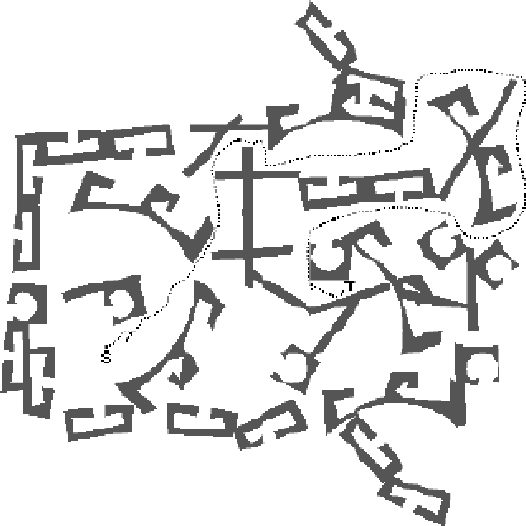
Figure 1: Human performance in a maze.
This contrast in the subjects' performance in the two tasks above poses a question as to whether a human-machine interface, perhaps with adequate machine intelligence, can be developed to improve human performance is such applications. The current work is an attempt to answer this question. The system we chose to model the problem is a two-dimensional (2D) revolute-revolute (RR) arm manipulator operating in an environment with unknown stationary obstacles (see Figure 2). The arm has two links moving in a plane, and two revolute joints (degrees of freedom). The idea it to present the problem to the human as one of moving a point in a maze (a task that humans are good at) rather than the actual problem of moving a jointed kinematic structure (which humans are not good at). We exploit the fact that for today's computer algorithms, which are based on spatial geometry and topology tools, both tasks present essentially the same maze-searching problem [7]. By transforming the problem to the arm configuration space (C-space), the arm is shrunk to a point in the space of its control variables.
Below, the properties of work space control are discussed in Section 2, and those of the configuration space - in Section 3. The proposed interface is then presented in Section 4, followed by some experimental results in Section 5 and discussion in Section 5.2.