


Overall, the proposed C-space control mode performed admirably when compared to the traditional W-space control. Current results (achieved with a C-space interface version that is still under development) show improvement in performance on the order of magnitude when switching from W-space control to the proposed C-space control. The path produced approaches the optimal (shortest) path and time to complete the task. Further, the cognitive part of the time spent in the case considered is negligible, since the 2D mazes produced by the virtual obstacles are simple to navigate and to learn. This remarkable fact puts the human operator ahead of the existing computer algorithms, contrary to the W-space control where human performance has been much worse. It also suggests interesting questions and extensions to more difficult 3D cases.
Table 1 summarizes information from a series of controlled experiments performed in 1996-97 at the UW Robotics Lab, to test human performance in motion planning tasks. One of the tasks given to the human subjects was to move a two-link arm, very similar to the one considered in this paper, from the start to target configurations. Only W-space control was available (Section 2). In the table, the path length is the integral of both joint angle changes during the motion; also given is the time ((in seconds) taken by subjects to complete the task. The data given represents the performance of 12 subjects on the second day of tests, after training and practice on the previous day. (The results on 48 untrained subjects, in tests with a simulated as well as physical arm manipulator, were quite similar). A full analysis of this work can be found in [5].

Table 1: Descriptive Statistics
No similar study was carried out for the C-space control mode. However, based on the observations and tests by these authors, the study is not necessary: the performance improvement is very clear and consistent. Further, it is clear that in the task of Figure 3 different subjects are likely to produce almost the same (nearly optimal) path, with the mean path length of about 12, the standard deviation of about zero, and the mean time below 1 min. The path length and time values in Table 2 show an order of magnitude improvement compared to the data on W-space control in Table 1. Sample results from 5 consecutive runs of C-space control are given in Table 2. One of these runs is shown in Figures 5 and 6.
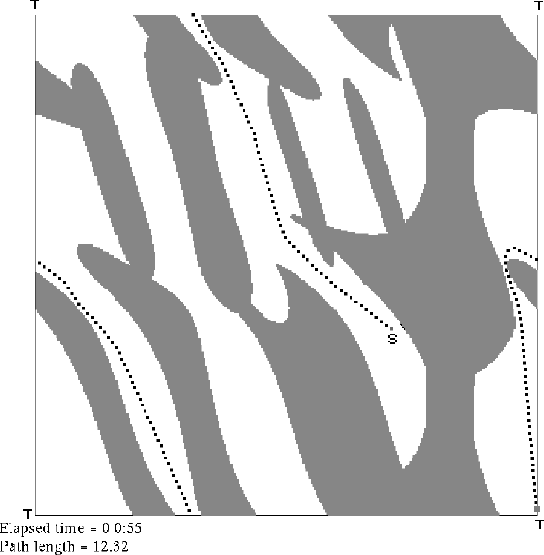
Figure: The sample task of Fig. 3: C-space motion control.
The corresponding W-space in Fig. 7.
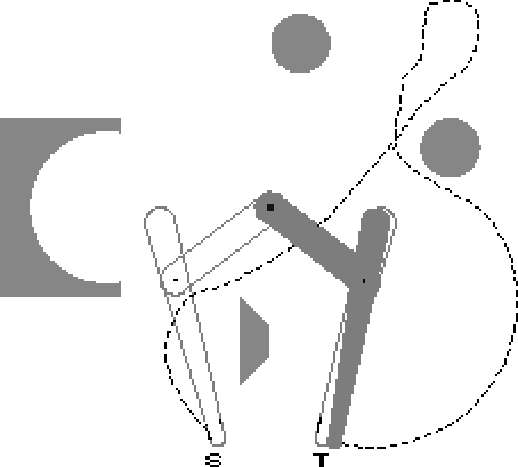
Figure: The W-space view of the task in Fig. 6.
The path produced does not contain unnecessary ``detours'' common to
W-space control (see Fig 4), and approaches optimal path
for this task.
The consistency between these runs - both in path length and completion time - is very similar to the subjects performance in a common maze-searching problem. It also stands in contrast to the wide range of results produced in the W-space model. This suggests that the proposed transformation to C-space control does indeed make the task at hand similar to the maze-searching task.
