Contents
- Introduction
- Hard Code Word
- Results
- Locality-constrained Linear
- Results
- Grid Search
- Sequential Hierarchy Classifier
- Manually assigned clusters
- Results
- Clusters from K-means
- Results
- Other Dataset Evaluation
- Birds
- Butterflies
- Other Experiments
- Results
- Scene Datasets
- Code
- Git Logs
- References
|
Hard Code Word Assignment
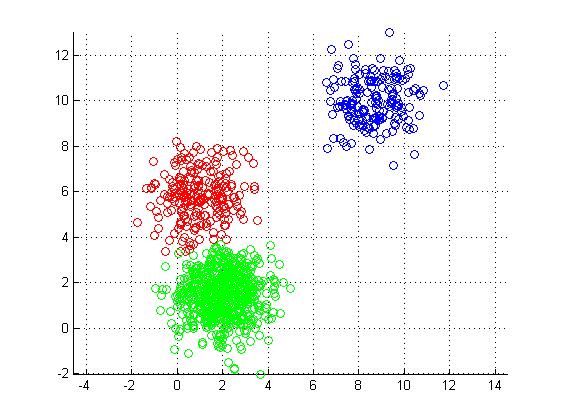 We began our experiment by running the spatial pyramid method with hard code word
assignment. When we say hard code word assignment, we mean that after different
clusters are generated using K-Means with our SIFT Descriptor features, each SIFT descriptor is
assigned to 1 and only 1 cluster (e.g. picture to the right as each point is assigned to either
red, blue, or green). This is contrasted with soft code word assignment (e.g. LLC)
where each SIFT descriptor contains a distribution of clusters it is assigned to where the values
assigned to each cluster is based on the descriptor's distance to the relevant cluster. Using the
hard codeword assignment, we first found results which were not too good where our accuracy
of prediction was in the 45% range. However, we discovered that this low accuracy was due
to the fact that we were not using any type of kernel function on our training and testing data.
Therefore, after we experimented using a histogram intersection kernel function, we saw
our prediction accuracy sharply rise up to 75%. Confusion matrices with and without
the histogram intersection kernel are shown below.
We began our experiment by running the spatial pyramid method with hard code word
assignment. When we say hard code word assignment, we mean that after different
clusters are generated using K-Means with our SIFT Descriptor features, each SIFT descriptor is
assigned to 1 and only 1 cluster (e.g. picture to the right as each point is assigned to either
red, blue, or green). This is contrasted with soft code word assignment (e.g. LLC)
where each SIFT descriptor contains a distribution of clusters it is assigned to where the values
assigned to each cluster is based on the descriptor's distance to the relevant cluster. Using the
hard codeword assignment, we first found results which were not too good where our accuracy
of prediction was in the 45% range. However, we discovered that this low accuracy was due
to the fact that we were not using any type of kernel function on our training and testing data.
Therefore, after we experimented using a histogram intersection kernel function, we saw
our prediction accuracy sharply rise up to 75%. Confusion matrices with and without
the histogram intersection kernel are shown below.
|